IB Chemistry Study Summary

Stoichiometry and Gas Laws

1
Balancing Equations

Introduction to Balancing Chemical Equations

Balancing chemical equations is a fundamental skill in chemistry, ensuring that the law of conservation of mass is upheld. This law states that matter cannot be created or destroyed in a chemical reaction, meaning the number of atoms of each element must be the same on both the reactant and product sides of an equation. To effectively balance equations, a systematic approach is required.

Consider the reaction of aluminium burning in air to form aluminium oxide as an illustrative example. This process involves several key steps to arrive at a balanced symbolic representation.

Diagram

Step-by-Step Balancing: Aluminium and Oxygen

The first step in balancing any chemical equation is to write out the word equation, which describes the reactants and products in plain language. For our example, this would be:

Aluminium + oxygen → aluminium oxide

Next, convert the word equation into a symbolic representation using the correct molecular formulae for each substance. At this stage, the equation might not be balanced:

Al + O2 → Al2O3

Now, we proceed to balance the atoms. It's often strategic to balance elements that appear in only one reactant and one product first. Let's begin by balancing the aluminium (Al) atoms. On the left side, there is one Al atom, and on the right side, there are two Al atoms. To balance this, we place a coefficient of '2' in front of Al on the reactant side:

2Al + O2 → Al2O3

Next, we balance the oxygen (O) atoms. There are two O atoms on the left side (in O2) and three O atoms on the right side (in Al2O3). To find the least common multiple, which is six, we need to adjust the coefficients. We place a '3' in front of O2 and a '2' in front of Al2O3:

2Al + 3O2 → 2Al2O3

After balancing the oxygen atoms, it's crucial to re-check the balance of all other elements, as changing one coefficient can affect others. In this case, re-balancing the aluminium atoms is necessary. With a coefficient of '2' in front of Al2O3, there are now 2 × 2 = 4 aluminium atoms on the product side. Therefore, we must change the coefficient for Al on the reactant side from '2' to '4':

4Al + 3O2 → 2Al2O3

This final equation is now balanced, with four aluminium atoms and six oxygen atoms on both sides of the reaction. The numbers placed in front of the chemical formulae (4, 3, and 2) are called coefficients.

Understanding Coefficients in Balanced Equations

The coefficients in a balanced chemical equation, such as those in 4Al + 3O2 → 2Al2O3, are critically important. They represent the molar ratio, or stoichiometry, of the reactants and products involved in the reaction. This means that 4 moles of aluminium react with 3 moles of oxygen gas to produce 2 moles of aluminium oxide. These ratios are essential for quantitative calculations in chemistry, allowing us to predict the amounts of reactants consumed and products formed.

Balancing Ionic Equations

When dealing with reactions involving ions, such as acid-base neutralizations or precipitation reactions, it is often useful to write ionic equations. Consider the reaction between hydrochloric acid (HCl) and sodium hydroxide (NaOH):

HCl + NaOH → NaCl + H2O

To write the ionic equation, we first dissociate all soluble ionic compounds and strong acids/bases into their respective ions:

H+(aq) + Cl-(aq) + Na+(aq) + OH-(aq) → Na+(aq) + Cl-(aq) + H2O(l)

Next, we identify and cross out the "spectator ions," which are ions that appear unchanged on both sides of the equation. In this case, Na+ and Cl- are spectator ions:

H+(aq) + Cl-(aq) + Na+(aq) + OH-(aq) → Na+(aq) + Cl-(aq) + H2O(l)

The remaining ions form the net ionic equation:

H+(aq) + OH-(aq) → H2O(l)

Finally, it is essential to check that the charges balance on both sides of the net ionic equation. In this example, (+1) + (-1) = 0 on the reactant side, and the product (H2O) is neutral, so the charges are balanced.

Essential Tips for Balancing Equations

Several key principles should be followed when balancing chemical equations:

  • Never change the subscripts within a chemical formula (e.g., changing O2 to O3). Subscripts define the identity of the compound; altering them changes the substance itself. Only coefficients can be adjusted.
  • When an element appears in multiple compounds on one side of the equation, it is often best to leave balancing that element for last.
  • Prioritize balancing elements with larger atomic masses or those that appear in only one compound on each side of the equation.
  • If you find yourself going through an excessive number of steps or cycles of re-balancing, it might indicate that you have used incorrect chemical formulae for one or more substances. Always double-check the formulae.
  • For ionic equations, the total charge must be balanced on both the reactant and product sides, in addition to the atom count.
  • Always perform a final double-check to ensure that all elements are balanced on both sides of the equation.

Relative Atomic Mass (Ar)

The relative atomic mass (Ar) of an element is a weighted average of the masses of all its naturally occurring stable isotopes. This average accounts for both the mass of each isotope and its relative abundance in nature. For instance, chlorine exists as two main isotopes: chlorine-35 and chlorine-37. The Ar for chlorine reflects the average mass based on the proportions of these two isotopes.

Relative Molecular Mass (Mr)

The relative molecular mass (Mr), also sometimes referred to as relative formula mass, is simply the sum of the relative atomic masses (Ar) of all the atoms present in a molecule or formula unit. To calculate the Mr of a compound, you add together the Ar values for each atom, taking into account the number of times each atom appears in the chemical formula. For example, to determine the "heaviness" of a compound, one would sum the Ar values of its constituent atoms.

2
Relative and Molar Mass

Calculating Relative Formula Mass (Mr)

To illustrate the calculation of relative formula mass (Mr), let's consider the example of carbon dioxide (CO2). This compound is composed of one carbon atom and two oxygen atoms. To determine the Mr, we sum the relative atomic masses (Ar) of all the atoms present in the chemical formula. For CO2, this involves:
  • One carbon atom, which has an Ar of 12.
  • Two oxygen atoms, each with an Ar of 16.
Therefore, the calculation is as follows:

1 carbon = 1 × 12 = 12

2 oxygen = 2 × 16 = +32

Total = 44

This value, 44, represents the relative formula mass of CO2

Solutions for Molar Mass Calculations

Here are the detailed calculations for the molar masses (Mr) of the compounds listed previously. Each calculation involves summing the relative atomic masses of all atoms present in the chemical formula.
Compound Calculation Mr
LiI 7 + 127 134
CH4 12 + (4 × 1) 16
CO2 12 + 16 + 16 44
HCl 1 + 35.5 36.5
H2SO4 (2 × 1) + 32 + (16 × 4) 98
NaCl 23 + 35.5 58.5
NH3 14 + (3 × 1) 17
MgCl2 24 + (35.5 × 2) 95
TiO 48 + 16 64
C6H12O6 (6 × 12) + (12 × 1) + (16 × 6) 180
Fe2O3 (2 × 56) + (3 × 16) 160
C4H10 (4 × 12) + (10 × 1) 58
MnO4 55 + (4 × 16) 119
C6H12 (6 × 12) + (12 × 1) 84
KMnO4 39 + 55 + (16 × 4) 158
Co2(SO4)3 (2 × 59) + (3 × 32) + (12 × 16) 406
Ni(CH3CO2)2 59 + (2 × 12) + (6 × 1) + (4 × 16) 177
Na2HPO4 (2 × 23) + 1 + 31 + (4 × 16) 142
3
The Mole Concept
Diagram

The Role of Mathematics in Chemical Quantification

The development of chemistry into a rigorous physical science has been profoundly influenced by the ability to assign precise numerical values to the masses of chemical elements. This quantitative approach allows for accurate predictions and understanding of chemical reactions. This raises a fundamental question in the theory of knowledge: why is mathematics so exceptionally effective in describing and predicting phenomena in the natural world? The inherent order and relationships within chemical systems often find perfect expression through mathematical principles.

Defining Avogadro's Constant and the Mole

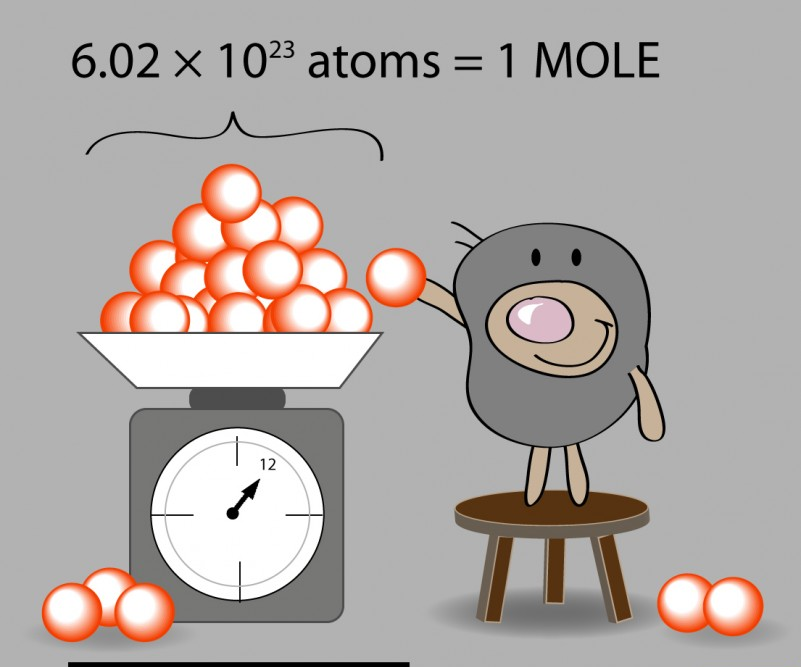
Avogadro's constant, a fundamental quantity in chemistry, represents the number of constituent particles (atoms, ions, molecules, or other specified particles) present in one mole of any substance. This value is approximately 6.02 x 10
Diagram
Diagram
23 and is typically provided in data booklets or in Paper 1 questions of the IB Chemistry examination. Individual atoms are infinitesimally small and light, making it impossible to weigh them directly using standard laboratory balances. However, by knowing the mass of an extremely large, defined number of atoms (one mole), we can then indirectly calculate the mass of a single atom.

Calculating Moles, Mass, and Molar Mass

The relationship between moles, mass, and molar mass is crucial for quantitative chemistry. The molar mass (M
Diagram
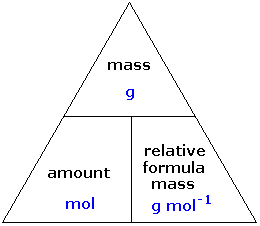
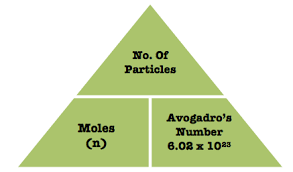
r), often expressed in grams per mole (g/mol), represents the mass of one mole of a substance. This relationship can be visualized using a "moles triangle" or simply understood through the formula: moles = mass / molar mass.

Key Definitions in Stoichiometry

Stoichiometry is the branch of chemistry that deals with the quantitative relationships between reactants and products in chemical reactions, primarily focusing on their relative molar quantities. Several key terms are essential for understanding stoichiometry:
  • Relative atomic mass (Ar): This is defined as the average mass of naturally occurring atoms of an element compared to 1/12th the mass of a carbon-12 atom.
  • Relative molecular mass/molar mass (Mr): This is the sum of all the relative atomic masses of the atoms present in a molecule or formula unit.
  • The mole: The mole is a unit of amount of substance, defined as containing 6.02 x 10²³ particles (whether atoms, molecules, or ions).
  • Avogadro’s constant (or number): This is the specific number of particles (6.02 x 10²³) found in one mole of any substance.

The Magnitude of Avogadro's Constant

Avogadro's constant is precisely 6.022 x 10²³. When referring to this number, it is generally not necessary to append units because it represents a count of discrete entities. The sheer magnitude of this number is immense, so much so that we use the term "mole" as a convenient way to refer to this specific quantity of particles. To truly grasp the scale of this number, one might consider watching a video like "the MOLE song," which often provides relatable analogies to illustrate its vastness.
Diagram

Calculating the Number of Particles

To determine the number of individual particles (atoms, molecules, or ions) within a given sample, one must first calculate the number of moles of the substance. Once the moles are known, multiplying this value by Avogadro's constant (6.02 x 10²³ particles/mol) will yield the total number of particles.

The Intuitive Challenge of Avogadro's Constant

The scale of Avogadro's constant is so immense that it extends far beyond the realm of our everyday experience. This vastness often challenges our intuition, making it difficult to truly conceptualize such a large number. Our daily lives are typically concerned with quantities that are easily countable or measurable within a human-perceptible range, limiting our ability to intuitively grasp magnitudes like 6.02 x 10²³.
4
Empirical and Molecular Formula

Introduction to Empirical and Molecular Formulas

Diagram

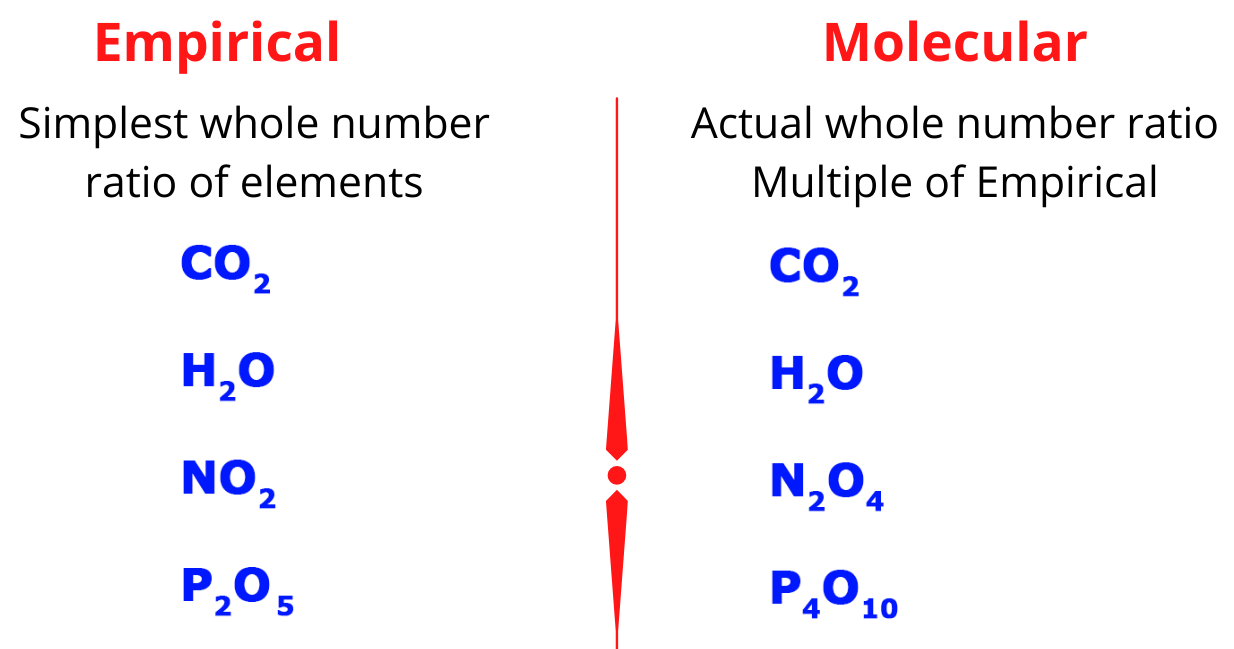
When analyzing chemical compounds, it's crucial to understand the distinction between empirical and molecular formulas. These two types of formulas provide different, yet complementary, information about the composition of a substance. The empirical formula represents the simplest whole-number ratio of atoms of each element present in a compound, while the molecular formula indicates the actual number of atoms of each element in a single molecule of the compound.

Consider a set of compounds. What similarities and differences might you observe in their formulas? For instance, two different compounds could share the same empirical formula but possess distinct molecular formulas, reflecting different overall numbers of atoms. Conversely, compounds with the same molecular formula will inherently have the same empirical formula.

Defining Empirical and Molecular Formulas

The empirical formula of a compound is the simplest whole-number ratio of atoms of each element present within that compound. It provides the most reduced form of the elemental composition. In contrast, the molecular formula represents the actual number of atoms of each element in a single molecule of the compound. This means the molecular formula can be the same as the empirical formula, or it can be a whole-number multiple of the empirical formula.

Diagram

Examples of Empirical and Molecular Formulas

Let's examine some examples to clarify the difference between empirical and molecular formulas. Consider the formula CH2. This represents an empirical formula, as the ratio of carbon to hydrogen atoms is 1:2, which cannot be simplified further. Similarly, H2O is both an empirical and a molecular formula, as the 2:1 ratio of hydrogen to oxygen is the simplest possible, and it also represents the actual composition of a water molecule. CH2O is another example of an empirical formula, with a 1:2:1 ratio of carbon, hydrogen, and oxygen.

Now, let's look at C6H12. This is a molecular formula. While it shows six carbon atoms and twelve hydrogen atoms, the ratio 6:12 can be simplified to 1:2. Therefore, its empirical formula would be CH2. This illustrates that a molecular formula provides the exact atomic count, while the empirical formula gives the simplest ratio.

Calculating Empirical Formula: A Worked Example

To calculate the empirical formula of a compound, we need to determine the simplest whole-number ratio of the moles of each element present. Let's work through an example: calculate the empirical formula of a compound containing 1.26g of titanium and 3.74g of chlorine.

The process involves several steps:

  1. Divide the mass of each element by its atomic mass (Ar) to find the number of moles.
  2. Divide each of these mole values by the smallest mole value obtained to find the simplest ratio.
  3. If necessary, multiply the ratios by a small whole number to obtain whole-number ratios for all elements.
  4. Use these whole-number ratios as subscripts to write the empirical formula.

Applying this to our example:

Titanium Chlorine
Mass (given in question) 1.26g 3.74g
Divide by Ar 1.26 / 47.87 = 0.0263 mol 3.74 / 35.45 = 0.106 mol
Divide by smallest 0.0263 / 0.0263 = 1 0.106 / 0.0263 = 4
Formula TiCl4

Therefore, the empirical formula of the compound is TiCl4.

Practice Calculation: Empirical Formula from Mass

Now, let's try another example. Suppose 18.39g of oxygen and 81.61g of chlorine are combined in a 100g sample of a compound. We need to calculate the empirical formula of this compound.

Following the same steps as before:

Oxygen Chlorine
Mass (given in question) 18.39g 81.61g
Divide by Ar 18.39g / 16.00 = 1.149 mol 81.61g / 35.45 = 2.302 mol
Divide by smallest 1.149 / 1.149 = 1 2.302 / 1.149 = 2
Formula OCl2

The empirical formula for this compound is OCl2.

Handling Non-Integer Ratios: The 0.5 Case

Sometimes, after dividing by the smallest mole value, you might encounter ratios that are not whole numbers but are close to a half (e.g., 1.5, 2.5). In such cases, you must multiply all the ratios by a small whole number to convert them into integers. Let's consider a compound formed from 28g of iron and 12g of oxygen.

Iron Oxygen
Mass (given in Q) 28g 12g
Divide by Ar 28g / 55.85 = 0.501 mol 12g / 16.00 = 0.750 mol
Divide by smallest 0.501 / 0.501 = 1 0.750 / 0.501 = 1.50
Not whole number! Find smallest whole number ratio = x 2 1 x 2 = 2 1.5 x 2 = 3
Formula Fe2O3

Since we obtained a ratio of 1.5 for oxygen, we multiplied both ratios by 2 to get the smallest whole numbers, resulting in the empirical formula Fe2O3.

Handling Non-Integer Ratios: The 0.35 Case

In some instances, the non-integer ratio might not be easily rounded or multiplied by 2. For example, if we have 28g of iron and 18.8g of oxygen in a compound, let's calculate its empirical formula.

Iron Oxygen
Mass (given in Q) 28g 18.8g
Divide by Ar 28g / 55.85 = 0.501 mol 18.8g / 16.00 = 1.175 mol
Divide by smallest 0.501 / 0.501 = 1 1.175 / 0.501 = 2.35
Not whole number! Not close enough to be rounded or doubled! Find smallest whole number ratio = x 3 1 x 3 = 3 2.35 x 3 = 7.05
Formula Fe3O7

Here, a ratio of 2.35 is not close enough to 2 or 2.5 to be rounded or simply doubled. Multiplying by 3 gives us 7.05, which is very close to 7, allowing us to determine the empirical formula as Fe3O7. It's important to recognize common fractional equivalents (e.g., 0.33 ≈ 1/3, 0.66 ≈ 2/3, 0.25 ≈ 1/4) and multiply by the appropriate integer to obtain whole numbers.

Calculating Empirical Formula from Percentage Mass

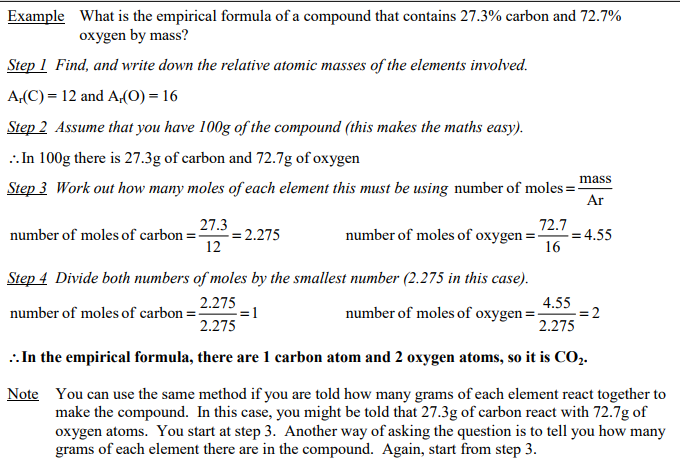
Empirical formulas can also be determined when the composition is given as percentage by mass. The approach is very similar, but instead of using grams, we assume a 100g sample, so the percentages directly translate to masses in grams. Let's calculate the empirical formula of a compound containing 16.4% potassium, 30.0% chlorine, and 53.6% iodine by mass.

The steps remain the same:

  1. Assume a 100g sample, so the percentages become masses in grams.
  2. Divide the mass (percentage) of each element by its atomic mass (Ar) to find the number of moles.
  3. Divide each of these mole values by the smallest mole value obtained to find the simplest ratio.
  4. If necessary, multiply the ratios by a small whole number to obtain whole-number ratios for all elements.
  5. Use these whole-number ratios as subscripts to write the empirical formula.
K Cl I
% by mass 16.4 30.0 53.6
Divide by Ar 16.4 / 39.10 = 0.419 mol 30.0 / 35.45 = 0.846 mol 53.6 / 126.9 = 0.422 mol
Divide by smallest 0.419 / 0.419 = 1 0.846 / 0.419 = 2 0.422 / 0.419 = 1
Formula KCl2I

The empirical formula for this compound is KCl2I.

Calculating Molecular Formula from Empirical Formula and Molar Mass

Once the empirical formula is determined, the molecular formula can be calculated if the molar mass (Mr) of the compound is known. The molecular formula is always a whole-number multiple of the empirical formula. This multiple is found by dividing the molar mass of the compound by the molar mass of the empirical formula.

Let's consider a compound with 0.282g of phosphorus and 0.218g of oxygen, and a known molar mass (Mr) of 220 g/mol.

First, we calculate the empirical formula:

Phosphorus Oxygen
Mass (given in Q) 0.282g 0.218g
Divide by Ar 0.282 / 30.97 = 0.00911 mol 0.218 / 16.00 = 0.0136 mol
Divide by smallest 0.00911 / 0.00911 = 1 0.0136 / 0.00911 = 1.496
Ensure whole # 1 x 2 = 2 1.496 x 2 = 2.992 ≈ 3
Formula P2O3

So, the empirical formula is P2O3.

Next, we calculate the molar mass of the empirical formula (Mr(EF)):

Mr(P2O3) = (2 x 30.97) + (3 x 16.00) = 61.94 + 48.00 = 109.94 g/mol (approximately 110 g/mol).

Now, we compare this to the given molar mass of the compound:

Ratio = Mr (compound) / Mr (empirical formula) = 220 / 110 = 2

This means the molecular formula is twice the empirical formula. Therefore, the molecular formula is P(2x2)O(3x2) = P4O6.

Diagram
5
Concentration and Dilutions

Quantifying Chemical Change

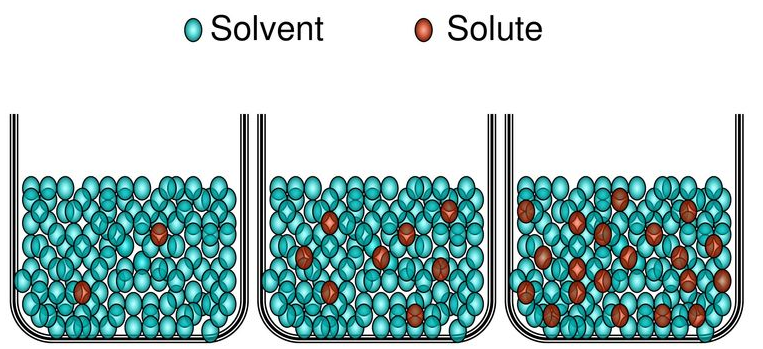
The amount of chemical change occurring in a reaction is a fundamental concept in chemistry. It is often expressed through the concentration of reactants and products. Visual representations, can help illustrate how the quantities of substances change during a chemical process.
Diagram

Defining and Calculating Concentration

Concentration is a measure of the amount of solute dissolved in a given volume of solvent or solution. It quantifies how much of a substance is present in a specific space. The most common unit for concentration in chemistry, particularly in the International Baccalaureate (IB) curriculum, is moles per cubic decimeter (mol dm-3). The relationship between concentration, moles, and volume can be expressed by the following formulas:

Concentration (Conc) = Moles (Mol) / Volume (dm3)

Moles (Mol) = Concentration (Conc) × Volume (dm3)

Volume (dm3) = Moles (Mol) / Concentration (Conc)

To illustrate this, consider the following examples comparing solutions with different concentrations:
1 mol in 1 dm3 5 mol in 1 dm3
1 mol dm-3 5 mol dm-3
58.5 g NaCl in 1 dm3 water 292.5 g NaCl in 1 dm3 water
58.5 g / 1 dm3 = 58.5 g/dm3 292.5 g / 1 dm3 = 292.5 g/dm3
58.5 g / 58.5 g mol-1 = 1 mol 292.5 g / 58.5 g mol-1 = 5 mol
The IB units of concentration are consistently expressed as mol dm-3.

The Concentration Triangle

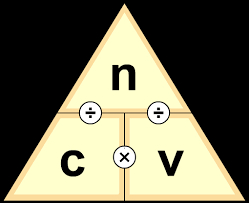
A useful mnemonic for remembering the relationship between moles, volume, and concentration is the "concentration triangle." This visual aid, depicted in
Diagram
, shows that:
  • Moles (mol) are at the top.
  • Volume (dm3) is at the bottom left.
  • Concentration (mol dm-3) is at the bottom right.
By covering the desired variable, the formula for its calculation is revealed.

Example Calculation of Concentration

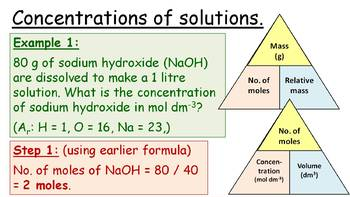
Let's calculate the concentration of a solution containing 80 g of NaOH in 1 dm3 of solution. First, determine the molar mass (Mr) of NaOH: Mr NaOH = 23 (Na) + 16 (O) + 1 (H) = 40 g mol-1. Next, calculate the number of moles of NaOH: Moles NaOH = Mass / M
Diagram
r = 80 g / 40 g mol-1 = 2 mol NaOH. Finally, calculate the concentration (M): Concentration (M) = Moles / Volume = 2 mol NaOH / 1 dm3 = 2 mol dm-3.

Diluting Solutions

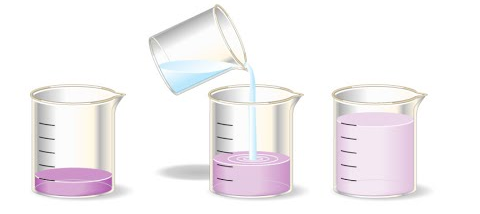
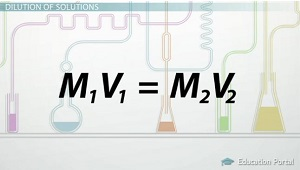
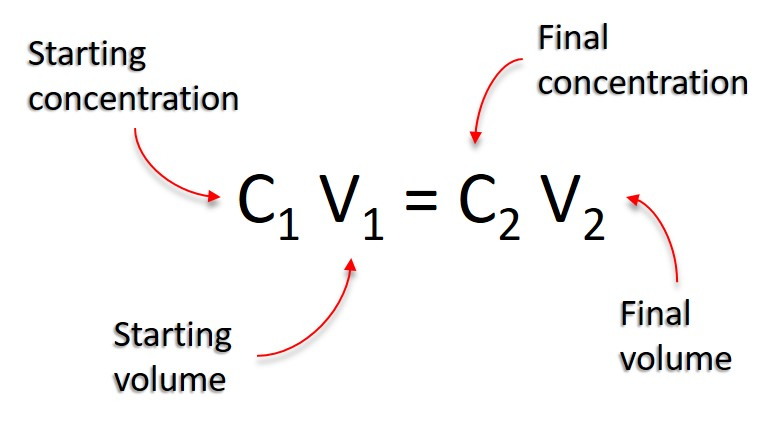
Dilution is the process of reducing the concentration of a solute in a solution, usually by adding more solvent. When diluting a solution, the amount of solute remains constant; only the volume of the solution changes. This principle is captured by the dilution equation: M1V1 = M2V2. In this equation:
Diagram
  • M1 represents the initial concentration (start conc).
  • V1 represents the initial volume (starting volume).
  • M2 represents the final concentration (final conc).
  • V2 represents the final volume (total volume).
The volume of water added during dilution can be calculated as V
Diagram
2 - V1.

Worked Example: Calculating Final Volume After Dilution

Consider a scenario where we have 10 cm3 of a 1.5 mol dm-3 HCl solution, and we need to dilute it to a final concentration of 0.1 mol dm-3. We want to determine the final volume of the solution. Using the dilution equation, M1V1 = M2V2: Given: M1 = 1.5 mol dm-3 V1 = 10 cm3 = 0.010 dm3 (ensure consistent units) M2 = 0.1 mol dm-3 V2 = ? Substitute the values into the equation: 1.5 × 0.010 = 0.1 × V2 Rearrange the equation to solve for V2: V2 = (1.5 × 0.010) / 0.1 V2 = 0.015 / 0.1 V2 = 0.15 dm3 Therefore, the final volume of the diluted solution would be 0.15 dm3. It is crucial to ensure that all units are consistent throughout the calculation.
Diagram

Worked Example: Calculating the Volume of Water to Add

Following on from the previous example, if we have 10 cm3 of a 1.5 mol dm-3 HCl stock solution and we need to make a 0.1 mol dm-3 solution with a final volume of 0.15 dm3, we can calculate the volume of water that needs to be added. As determined previously, the final volume (V2) is 0.15 dm3. The initial volume (V1) of the stock solution is 10 cm3, which is 0.01 dm3. The volume of water added is the difference between the final volume and the initial volume: Water added = V2 - V1 Water added = 0.15 dm3 - 0.01 dm3 Water added = 0.14 dm3 Thus, 0.14 dm3 (or 140 cm3) of water would need to be added to the initial 10 cm3 of stock solution to achieve the desired dilution.
6
Standard Solutions & Titrations

Preparing Standard Solutions

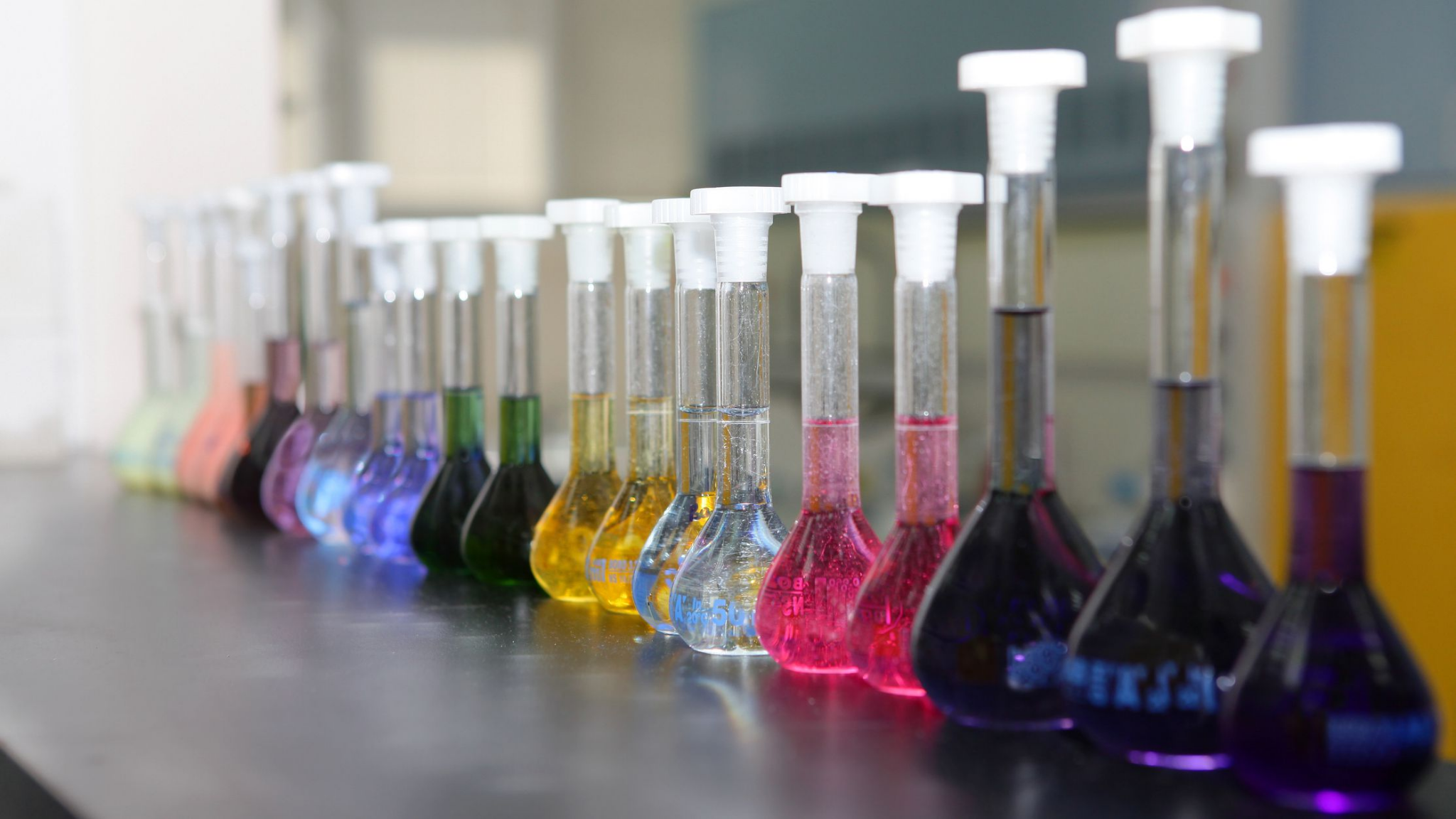
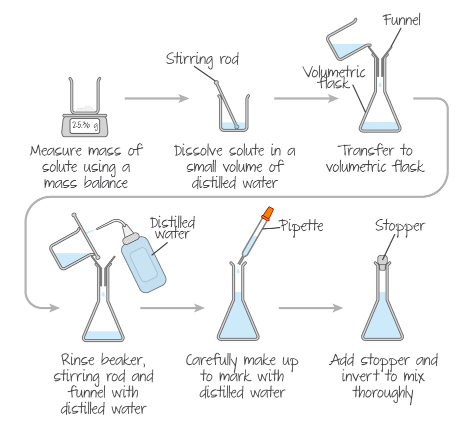
To prepare a standard solution, which is a solution with an accurately known concentration, the process begins with precisely measuring the mass of the solute using a balance that can measure to at least two decimal places. This ensures high accuracy in the initial quantity of the substance. The measured solute is then dissolved in a small volume of distilled water within a beaker, using a stirring rod to facilitate dissolution. Once dissolved, the solution is carefully transferred to a volumetric flask using a funnel. To ensure that all of the solute is transferred and none is left behind, the beaker, stirring rod, and funnel are thoroughly rinsed with distilled water, and these rinsings are also poured into the volumetric flask. Finally, distilled water is added to the volumetric flask until the solution reaches the required volume mark. A stopper is then placed on the flask, and it is inverted several times to ensure the solution is thoroughly mixed and homogeneous.
Diagram

Detailed Procedure for Solution Preparation

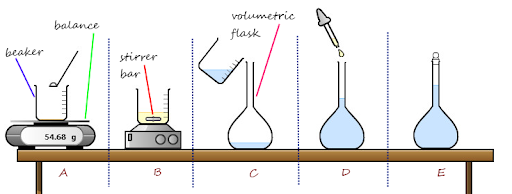
The preparation of a solution involves several critical stages to ensure accuracy. The first stage involves transferring a known mass of the solid solute. This is achieved by weighing the solid into a weighing boat and recording its mass to an appropriate precision. The solid is then transferred to a beaker. To account for any solid residue left in the weighing boat, it is re-weighed, and the difference in mass is calculated. Alternatively, the weighing boat can be rinsed directly into the beaker to ensure all solute is transferred. The second stage focuses on dissolving the solid in distilled water. The minimum amount of distilled water required to dissolve the solid is added to the beaker. The mixture is then stirred with a glass rod until the solid has completely dissolved. It is crucial not to add too much distilled water at this point, as it might leave insufficient volume for rinsing glassware later without overshooting the final desired volume of the solution. The third and final stage involves rinsing all glassware and making up the solution to its final volume. The dissolved solution is transferred to a volumetric flask, typically 250 cm
Diagram
3, using a funnel. All glassware that has been in contact with the solution, including the glass rod, beaker, and funnel, must be thoroughly rinsed with distilled water, and these rinsings are added to the volumetric flask. This step is vital to ensure that every particle of solute makes its way into the volumetric flask. Distilled water is then added up to the graduation line on the volumetric flask. After reaching the mark, the flask is stoppered and inverted several times to ensure the final solution is fully mixed and homogeneous before use. This mixing step should only be performed after the solution has been made up to the graduation mark.  

Characteristics of Primary Standard Solutions

A standard solution is defined as a solution with an accurately known concentration. A primary standard solution is specifically prepared using a primary standard, which is a substance possessing several key properties that make it suitable for this purpose. These properties include high purity, typically 99.9% or greater, a high molar mass to minimize the impact of weighing errors, and low reactivity to ensure stability. Furthermore, a primary standard should not change its composition when exposed to air, preventing reactions with atmospheric components like carbon dioxide or water vapor. Examples of substances commonly used as primary standards include sodium carbonate (Na2CO3), oxalic acid (H2C2O4), potassium hydrogen iodate (K(HIO3)2), and potassium dichromate (K2Cr2O7).
Diagram

Understanding Secondary Standard Solutions

In contrast to primary standard solutions, a secondary standard solution is one whose concentration has been determined by standardizing it against a primary standard solution. For instance, a sodium hydroxide solution, which is hygroscopic and reacts with atmospheric carbon dioxide, cannot be prepared directly as a primary standard. Instead, its concentration is accurately determined by titrating it against a primary standard acid, such as oxalic acid. Once standardized, the sodium hydroxide solution can then be used as a secondary standard solution. The use of both primary and secondary standard solutions with accurately known concentrations is fundamental in volumetric analysis, particularly in techniques like titration.

Introduction to Volumetric Analysis

Volumetric analysis is a quantitative analytical method that relies on measuring the volume of a solution of known concentration required to react completely with a solution of unknown concentration. This technique is crucial for determining the concentration of an unknown substance.
Diagram


The Titration Technique

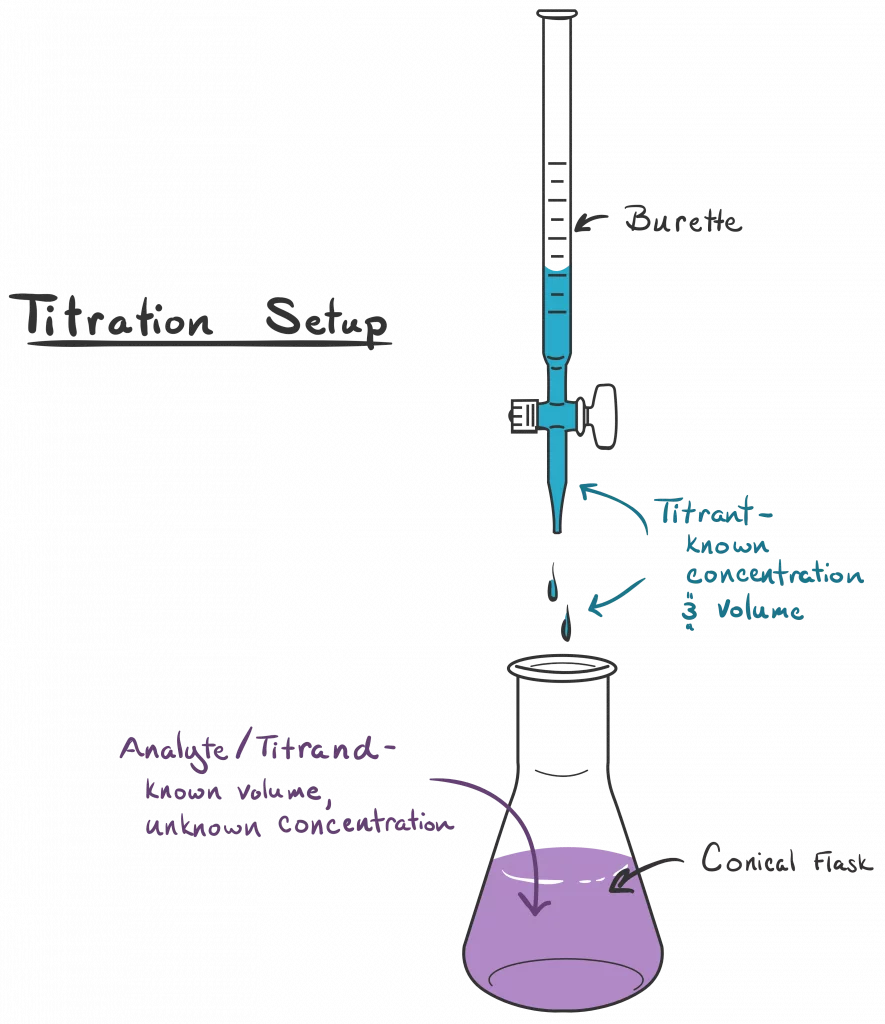
Titration is a specific technique within volumetric analysis used to calculate the unknown concentration (in mol dm-3) of a solution. This is most commonly achieved through a neutralization reaction between an acid and an alkali. During a titration, a solution of known concentration (the titrant) is gradually added to a solution of unknown concentration (the analyte) until the reaction is complete, indicated by a color change from an appropriate indicator.

The Concept of Neutralization

Neutralization is a chemical reaction that occurs when an acid
and a base (or an alkali, which is a soluble base) react to form a
neutral solution, typically consisting of a salt and water. This
reaction is fundamental to many titration experiments, particularly
acid-base titrations.

Acid-Base Titration Principles

Acid-base titrations are a common application of neutralization
reactions to determine unknown concentrations.

Proper Use of Pipettes and Burettes in Titration

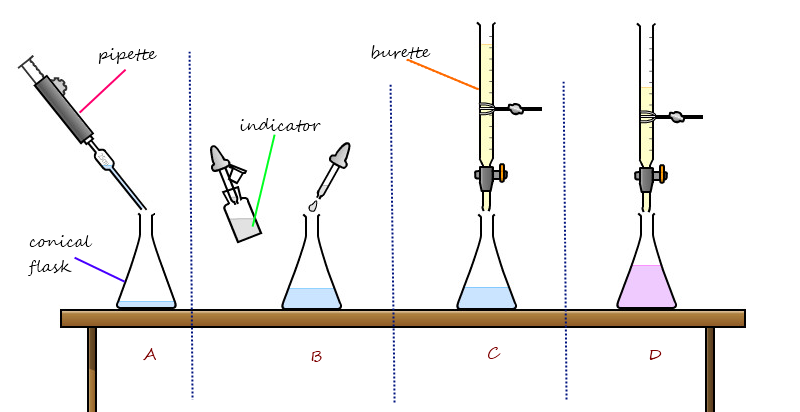
Accurate titration relies on the correct use of specialized glassware, specifically pipettes and burettes. The solution of known concentration, referred to as the titrant, is typically placed in the burette, while the unknown solution, known as the analyte, is placed in the conical flask. It is crucial to ensure that the top of the burette is at eye level or below when filling to avoid errors in reading the volume. The titration proceeds by adding the titrant from the burette to the analyte in the flask until the endpoint is reached, which is indicated by a distinct color change of an added indicator.

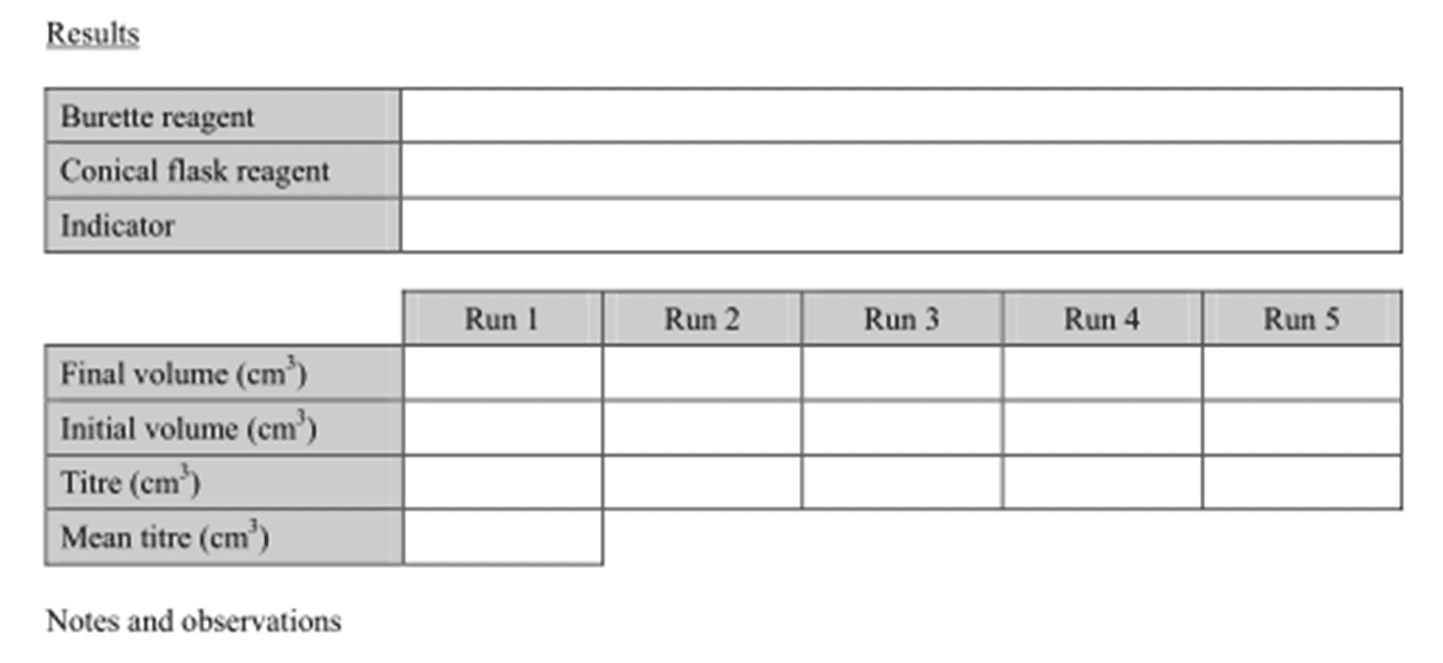
Recording Titration Results

All titration readings, including initial and final volumes, must be recorded to two decimal places to maintain precision. For example, readings should be recorded as 26.30 cm3, 26.35 cm3, or 26.40 cm3.

Step-by-Step Titration Procedure

Performing a titration involves several distinct stages to ensure accurate results.
Stage 1: Preparing the Conical Flask
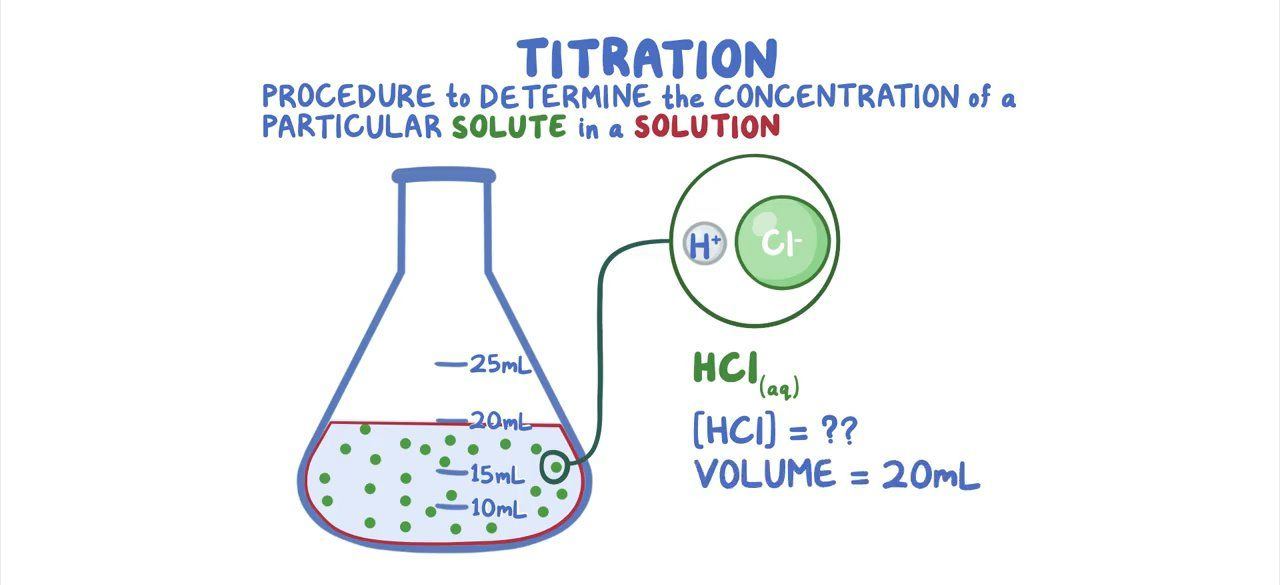
First, a solution with an unknown concentration is accurately transferred into a conical flask using a glass pipette. Subsequently, several drops of an appropriate indicator are added to the conical flask. Any solution adhering to the sides of the flask is rinsed down into the main body of the solution with distilled water.
Stage 2: Preparing the Burette
The burette is filled with the solution of known concentration (the titrant) using a funnel. Before starting the titration, a small amount of the solution is run through the burette into a waste container to ensure that there are no air bubbles present in the tip and that the burette walls are conditioned with the solution. The funnel is then removed from the burette.
Stage 3: Performing the Titration
The conical flask is placed on a white piece of paper directly beneath the burette to clearly observe any color changes. The starting volume of the burette is recorded, which is often 0.00 cm3. The titrant is then slowly added from the burette to the conical flask, while continuously swirling the flask, until a permanent color change is observed, indicating the endpoint of the reaction. The final volume in the burette is recorded, and the titre (the volume of solution required to reach the endpoint) is calculated. This entire process is repeated until concordant results are achieved, typically within 0.20 cm3 for at least four runs. A mean titre is then calculated from these concordant results.

Calculating Unknown Concentrations from Titration Data

To calculate the unknown concentration of a solution from titration data, a systematic approach is followed. First, it is helpful to sketch the experimental setup, noting all known volumes and concentrations. A balanced chemical equation for the reaction is then written. The next step involves calculating the moles of the solution whose concentration was known (the titrant). Using the stoichiometry from the balanced chemical equation, the moles of the reacting substance in the unknown solution (the analyte) are determined. Finally, using the calculated moles and the known volume of the unknown substance, its concentration can be determined.

Example Calculation of Unknown Concentration

Consider the neutralization reaction between hydrochloric acid (HCl) and sodium hydroxide (NaOH): HCl (aq) + NaOH (aq) → NaCl (aq) + H2O (l) In an experiment, 100 cm3 of NaOH solution with an unknown concentration is titrated with 0.120 mol dm-3 HCl. The titration results are recorded in the table below:
Volume /± 0.05 cm3 Trial 1 Trial 2 Trial 3
Initial Volume 22.10 42.90 22.80
Final Volume 1.20 22.15 2.00
Titre 20.90 20.75 20.80
To calculate the mean titre, we consider the concordant results. Let's assume the concordant results are Trial 2 and Trial 3, which are 20.75 cm3 and 20.80 cm3 respectively. The mean titre would be (20.75 + 20.80) / 2 = 20.775 cm3. For calculation purposes, we will use the provided mean titre from the next table.
Trial 1 Trial 2 Trial 3
Initial Volume /± 0.05 cm3 22.10 42.90 22.80
Final Volume /± 0.05 cm3 1.20 22.15 2.00
Titre /± 0.10 cm3 20.90 20.75 20.80
Mean titre /± 0.10 cm3 20.82
Using the mean titre of 20.82 cm3 (or 0.02082 dm3), we can calculate the moles of the titrant (HCl):
Moles of HCl = Concentration × Volume = 0.120 mol dm-3 × 0.02082 dm3 = 0.0024984 mol HCl.
From the balanced chemical equation, 1 mole of HCl reacts with 1 mole of NaOH. Therefore, the moles of NaOH that reacted in the flask are also 0.0024984 mol. The original volume of NaOH in the flask was 100 cm3 (or 0.100 dm3). Now, we can calculate the concentration of NaOH:
Concentration of NaOH = Moles / Volume = 0.0024984 mol / 0.100 dm3 = 0.024984 mol dm-3.
Rounding to an appropriate number of significant figures, the concentration of NaOH is approximately 0.0250 mol dm-3.

Propagation of Uncertainty in Titration Calculations

When performing calculations involving experimental data, it is crucial to propagate uncertainties to determine the overall uncertainty in the final result.
For the reaction HCl (aq) + NaOH (aq) → NaCl (aq) + H2O (l), let's assume the uncertainty of the HCl concentration was ±0.002 mol dm-3 and the uncertainty of the volume of titrant (mean titre) was ±0.10 cm3 (or ±0.0001 dm3). When quantities are multiplied, their percentage uncertainties are added.
First, calculate the percentage uncertainty for the HCl concentration:
% uncertainty HCl concentration = (0.002 / 0.120) × 100% = 1.667%
Next, calculate the percentage uncertainty for the volume of HCl:
% uncertainty volume HCl = (0.0001 / 0.02082) × 100% = 0.4803%
Adding these percentage uncertainties gives the total percentage uncertainty for the moles of HCl, which is also the percentage uncertainty for the moles of NaOH due to the 1:1 stoichiometric ratio:
Total % uncertainty = 1.667% + 0.4803% = 2.1473% ≈ 2.15%

Further Propagation of Uncertainty for Final Concentration

To calculate the uncertainty of the final concentration of NaOH, the percentage uncertainties of the moles of NaOH and the volume of NaOH must be added.
Assuming the absolute uncertainty of the volume of NaOH (100 cm3) was ±0.05 cm3 (or ±0.00005 dm3): Calculate the percentage uncertainty for the volume of NaOH:
% uncertainty volume NaOH = (0.00005 / 0.100) × 100% = 0.05%
Now, add the percentage uncertainty for the moles of NaOH (calculated previously as 2.15%) and the percentage uncertainty for the volume of NaOH:
Total % uncertainty for NaOH concentration = 2.15% + 0.05% = 2.20%
Finally, convert this percentage uncertainty back to an absolute uncertainty for the NaOH concentration: Absolute uncertainty = 0.0250 mol dm-3 × (2.20 / 100) = 0.00055 mol dm-3.
Therefore, the concentration of NaOH can be reported as 0.0250 mol dm-3 ± 0.0006 mol dm-3 (rounded to one significant figure for the uncertainty).

Standard Titration Results Table Format

When recording titration results, it is essential to use a consistent and clear format. All titration readings, including initial and final volumes, should always be recorded to two decimal places, for example, 26.30 cm3, 26.35 cm3, or 26.40 cm3. A standard table format helps organize the data effectively.

Diagram
Diagram
Diagram
7
Parts Per Million (ppm)

Understanding Parts Per Million (ppm)

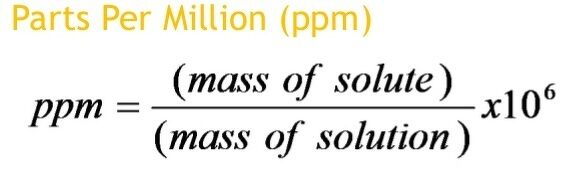
Parts per million (ppm) serves as a crucial unit for expressing the concentration of very dilute solutions. This measurement indicates the number of parts of a solute present in one million parts of the solvent or solution. It is particularly useful when dealing with extremely small quantities of substances, such as pollutants in water or air.

Calculating Concentration in ppm

The concentration in parts per million (ppm) can be directly equated to the mass of the solute in milligrams per cubic decimeter (mg dm-3). This relationship simplifies calculations, as 1 mg dm-3 is equivalent to 1 ppm.
Diagram
To illustrate this concept, consider the following examples:

Example Calculations for ppm

Let's work through some practical examples to solidify the understanding of ppm calculations.
Question 1: A solution has a concentration of 1.25 g dm-3. What is its concentration in ppm?
To solve this, we first need to convert the mass of the solute from grams to milligrams, as ppm is defined in terms of milligrams per cubic decimeter. 1.25 g = 1.25 × 1000 mg = 1250 mg
Now, we can re-express the concentration in mg dm-3:
Concentration = 1250 mg dm-3 Since 1 mg dm-3 is equivalent to 1 ppm, the concentration in ppm is: Concentration = 1250 ppm
Question 2: A solution has a concentration of 0.5 mg cm-3. What is its concentration in ppm?
In this case, we need to convert the volume from cubic centimeters (cm3) to cubic decimeters (dm3). We know that 1 dm3 is equal to 1000 cm3. Therefore, to express the concentration in mg dm-3, we multiply the given concentration by 1000:
Concentration = 0.5 mg cm-3 × (1000 cm3 / 1 dm3) = 500 mg dm-3
Again, since 1 mg dm-3 equals 1 ppm, the concentration in ppm is:
Concentration = 500 ppm 
8
Limiting Reactants

Understanding Limiting and Excess Reactants in Chemical Reactions

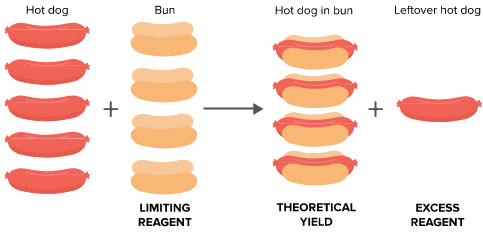
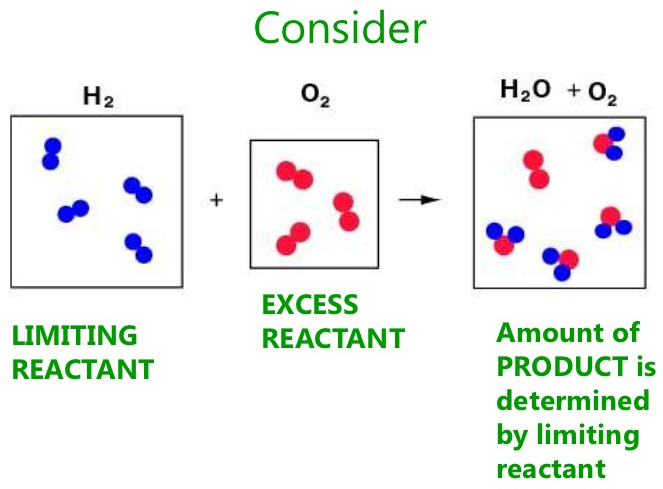
In many chemical reactions, reactants are not present in the exact stoichiometric ratios required for complete consumption. This often means that one reactant will be entirely used up before the others, thereby limiting the amount of product that can be formed. This reactant is known as the limiting reactant. Conversely, the reactant (or reactants) that remains after the limiting reactant has been consumed is said to be in excess. Identifying the limiting reactant is crucial for accurately predicting the theoretical yield of a reaction.
Diagram

Determining the Limiting Reactant

To identify the limiting reactant, it is necessary to calculate the number of moles of each reactant available. These calculated mole values are then compared to the stoichiometric molar ratios derived from the balanced chemical equation. The reactant that would produce the least amount of product, based on its available moles and the reaction's stoichiometry, is the limiting reactant.
Diagram

Example 1: Calculating Chlorine Gas Production and Identifying the Limiting Reactant

Consider the reaction between iron(III) chloride (FeCl3) and oxygen (O2) to produce iron(III) oxide (Fe2O3) and chlorine gas (Cl2). If 6 g of FeCl3 react with 4 g of O2, we need to determine the amount of chlorine gas produced and identify the limiting reactant. First, the unbalanced equation FeCl3 + O2 → Fe2O3 + Cl2 must be balanced to establish the correct stoichiometric ratios: 4FeCl3 + 3O2 → 2Fe2O3 + 6Cl2 Next, we calculate the moles of each reactant. It is important to remember that the coefficients from the balanced equation are used for molar ratios, not for calculating the molar mass (Mr) of the individual compounds.
4FeCl3 + 3O2 2Fe2O3 + 6Cl2
mass: 6 g 4 g
Mr: 56 + (35.5 × 3) = 162.5 g/mol 2 × 16 = 32 g/mol
mol: 6 / 162.5 = 0.0369 mol 4 / 32 = 0.125 mol
To determine the limiting reactant, we compare the actual mole ratio of the reactants to the required stoichiometric mole ratio. The required molar ratio of FeCl3 to O2 is 4:3, which is approximately 1.33. The actual molar ratio of FeCl3 to O2 present is 0.0369 mol / 0.125 mol = 0.295. Since the actual ratio (0.295) is less than the required ratio (1.33), it indicates that FeCl3 is the limiting reactant because there is not enough FeCl3 relative to O2 to satisfy the stoichiometric requirement.

Example 2: Calculating Water Production and Identifying the Limiting Reactant

Consider the combustion of ethane (C2H6) with oxygen (O2) to produce carbon dioxide (CO2) and water (H2O). If 15 g of C2H6 react with 45 g of O2, we need to determine the mass of water produced. The balanced chemical equation is: 2C2H6 + 7O2 → 4CO2 + 6H2O The first step is to calculate the moles of each reactant and identify the limiting reactant, as this will dictate the maximum amount of product that can be formed.
2C2H6 + 7O2 4CO2 + 6H2O
mass: 15 g 45 g
Mr: (2 × 12.01) + (6 × 1.01) = 30.08 g/mol (2 × 16.00) = 32.00 g/mol
mol: 15 / 30.08 = 0.499 mol 45 / 32.00 = 1.41 mol
To identify the limiting reactant, we compare the actual mole ratio of C2H6 to O2 with the stoichiometric ratio. The required molar ratio of C2H6 to O2 is 2:7, which is approximately 0.286. The actual molar ratio of C2H6 to O2 present is 0.499 mol / 1.41 mol = 0.354. Since the actual ratio (0.354) is greater than the required ratio (0.286), it means that C2H6 is in excess, and O2 is the limiting reactant. Therefore, the calculations for product formation must be based on the moles of O2. Using the moles of the limiting reactant (O2), we can calculate the moles of water produced.
From the balanced equation, 7 moles of O2 produce 6 moles of H2O.
Moles of H2O = (1.41 mol O2) × (6 mol H2O / 7 mol O2) = 1.21 mol H2O.
 Finally, to find the mass of water produced, we multiply the moles of water by its molar mass (Mr of H2O = (2 × 1.01) + 16.00 = 18.02 g/mol).
Mass of H2O = 1.21 mol × 18.02 g/mol = 21.80 g.
2C2H6 + 7O2 4CO2 + 6H2O
mass: 15 g 45 g 21.80 g
Mr: (2 × 12.01) + (6 × 1.01) = 30.08 g/mol (2 × 16) = 32 g/mol (1.01 × 2) + 16 = 18.02 g/mol
mol: 15 / 30.08 = 0.499 mol 45 / 32 = 1.41 mol 1.21 mol

Example 3: Determining Limiting Reactant and Product Mass for Zinc Chloride Formation

Let's consider the reaction between zinc (Zn) and hydrochloric acid (HCl) to produce zinc chloride (ZnCl2) and hydrogen gas (H2). If 2 g of Zn react with 3 g of HCl, we need to determine the mass of ZnCl2 produced and identify the limiting reactant. The balanced chemical equation is: Zn + 2HCl → ZnCl2 + H2 First, we calculate the moles of each reactant:
Zn + 2HCl ZnCl2 + H2
mass: 2 g 3 g
Mr: 65 g/mol 1 + 35.5 = 36.5 g/mol
mol: 2 / 65 = 0.0308 mol 3 / 36.5 = 0.0822 mol
To identify the limiting reactant, we compare the actual mole ratio of Zn to HCl with the stoichiometric ratio. The required molar ratio of Zn to HCl is 1:2, which is 0.5. The actual molar ratio of Zn to HCl present is 0.0308 mol / 0.0822 mol = 0.375. Since the actual ratio (0.375) is less than the required ratio (0.5), Zn is the limiting reactant. Now, using the moles of the limiting reactant (Zn), we can calculate the moles of ZnCl2 produced. From the balanced equation, 1 mole of Zn produces 1 mole of ZnCl2.
Moles of ZnCl2 = 0.0308 mol Zn × (1 mol ZnCl2 / 1 mol Zn) = 0.0308 mol ZnCl2.
Finally, to find the mass of ZnCl2 produced, we multiply the moles of ZnCl2 by its molar mass (Mr of ZnCl2 = 65 + (35.5 × 2) = 136 g/mol).
Mass of ZnCl2 = 0.0308 mol × 136 g/mol = 4.19 g.
Zn + 2HCl ZnCl2 + H2
mass: 2 g 3 g 4.19 g
Mr: 65 g/mol 1 + 35.5 = 36.5 g/mol 65 + (35.5 × 2) = 136 g/mol
mol: 2 / 65 = 0.0308 mol 3 / 36.5 = 0.0821 mol 0.0308 mol
9
Theoretical and Percent Yield

Stoichiometry and Limiting Reactants

The heat generated by an acetylene torch is a result of the combustion of acetylene (C2H2) in the presence of oxygen. This chemical reaction can be represented by the unbalanced equation:
2C2H2 + 5O2 → 4CO2 + 2H2O. To determine the maximum amount of water that can be produced from specific quantities of reactants, such as 2.40 mol of C2H2 and 7.40 mol of O2, one must first identify the limiting reactant. The limiting reactant is the reactant that is completely consumed in a chemical reaction and thus determines the maximum amount of product that can be formed. Acetylene, also systematically known as ethyne, is one of the key reactants in this process.

Defining Theoretical and Actual Yields

The calculated answer for the maximum amount of product that can be formed from a given set of reactants, assuming 100% reaction efficiency, is known as the theoretical yield. This represents the absolute maximum quantity of product obtainable under ideal conditions. In contrast, the actual yield refers to the amount of product that is practically obtained when the chemical reaction is performed in a laboratory setting. The actual yield is almost always less than the theoretical yield due to various factors such as incomplete reactions, side reactions, and loss of product during purification.

Calculating Percent Yield

The efficiency of a chemical reaction is quantified by its percent yield, which indicates how successful the reaction has been in converting reactants into desired products. The percent yield is calculated as the ratio of the actual yield to the theoretical yield, multiplied by 100 to express it as a percentage. This provides a valuable metric for evaluating the effectiveness of a synthetic procedure. The formula for percent yield is:

Percent Yield = (Actual Yield / Theoretical Yield) × 100%

For example, if the actual yield of water in the previously discussed reaction was 25.0 g, and the theoretical yield was calculated, the percent yield could then be determined using this formula.
10
Atom Economy

Understanding Atom Economy and Reaction Efficiency

Even when a chemical reaction achieves a 100% yield, meaning all reactants are converted into products, it may not be considered efficient in a broader sense. This is because many reactions generate by-products that have little or no practical use. Atom economy serves as a crucial metric to assess the efficiency of a reaction by quantifying the proportion of the mass of useful products relative to the total mass of all reactants consumed. A higher atom economy indicates a more sustainable and environmentally friendly process, as less waste is generated.

Calculating Atom Economy

The atom economy is calculated using the following formula: The formula can be expressed as: Essentially, it is the ratio of the molecular mass of the desired useful product(s) to the total molecular mass of all reactants, multiplied by 100 to express it as a percentage.

Example: Atom Economy in Hydrochloric Acid Production

Consider the production of hydrochloric acid (HCl) through the reaction between sodium chloride (NaCl) and sulfuric acid (H2SO4): In this reaction, the useful product is hydrochloric acid (HCl). To calculate the atom economy, we need the molecular masses of the useful product and all reactants:
Molecular mass of useful product (HCl): 36.46 g mol-1 
Molecular mass of reactant 1 (NaCl): 58.44 g mol-1 
Molecular mass of reactant 2 (H2SO4): 98.08 g mol-1
The atom economy for this reaction would be calculated as:
Atom Economy = MM useful product(s)/MM reactants x 100 
Atom Economy = MM HCl/[MM NaCl + MM H2SOx 100
Atom Economy = 36.46 g mol-1/[58.44 g mol-1 + 98.08 g mol-1 x 100 
Atom Economy = 23.3%
11
Avogadro's Law & Volumes

Introduction to Gas Laws

The behavior of gases can be described by several fundamental laws, which relate their pressure, volume, temperature, and the amount of substance present. These gas laws provide a framework for understanding how gases respond to changes in their environment.
Diagram

Avogadro's Law: Moles and Volumes of Gases

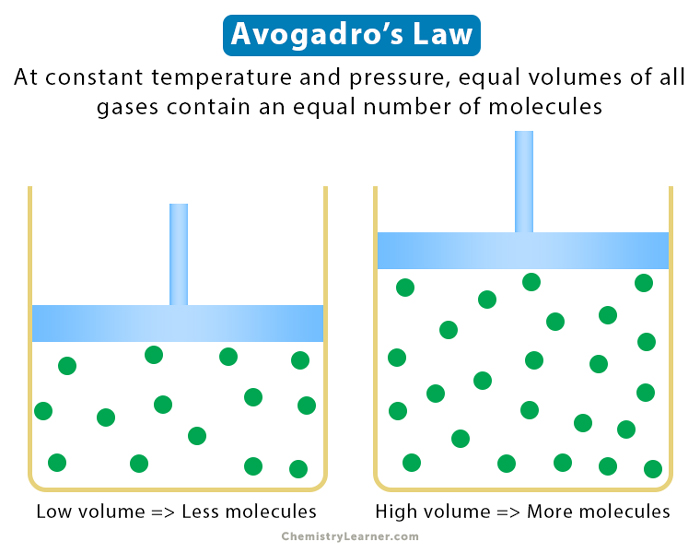
Avogadro's Law is a crucial principle in chemistry, stating that equal amounts of moles of gases will occupy the same volume, provided they are under identical conditions of temperature and pressure. This implies that equal volumes of different gases, when measured at the same temperature and pressure, will contain the same number of molecules or individual atoms. Consequently, this law allows for the direct determination of the mole ratio of reacting gases simply by observing their volume ratios.
Diagram

Calculating Volumes of Gases

The relationship between the amount of a gas and its volume is fundamental for stoichiometric calculations involving gaseous reactants and products.

Standard Temperature and Pressure (STP)

For consistent calculations and comparisons, a set of standard conditions known as Standard Temperature and Pressure (STP) has been defined. These conditions are a temperature of 273 K (0 °C) and a pressure of 100 kPa. It is important to note that these specific values for STP are typically provided in chemistry data booklets, such as section 1 for IB Chemistry.
Diagram
12
Introductory Gas Laws
Diagram

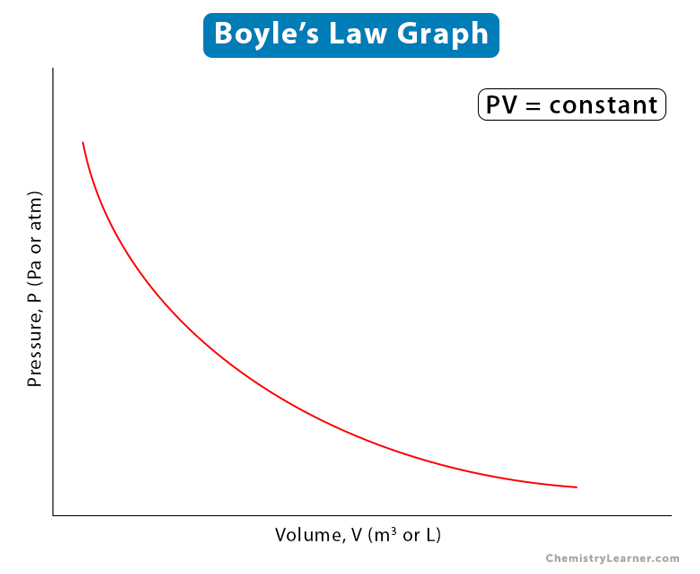
Boyle's Law: The Inverse Relationship Between Pressure and Volume

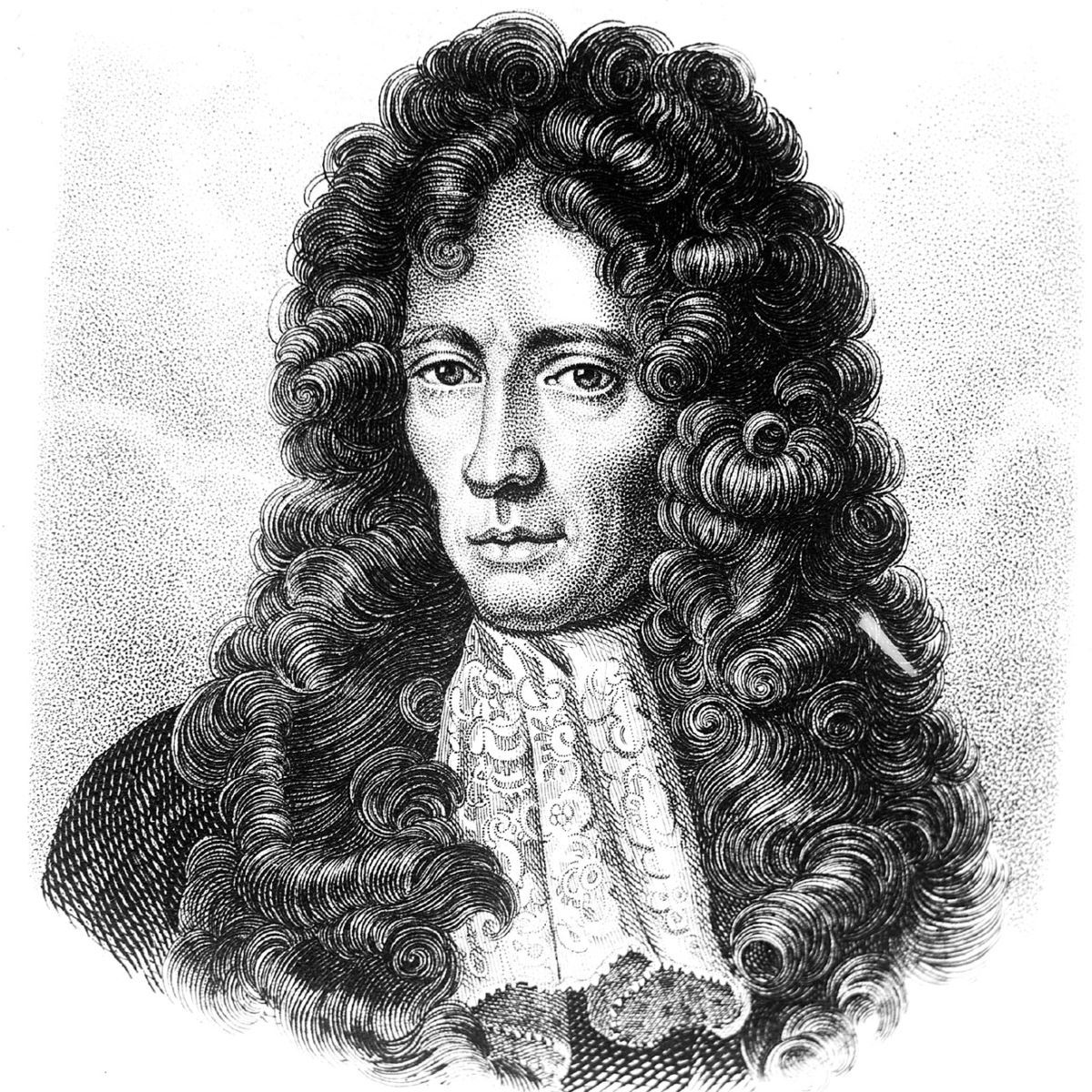
For a fixed mass of gas maintained at a constant temperature, the pressure and volume are inversely proportional. This relationship, known as Boyle's Law, can be expressed mathematically as PV = constant (k). Consequently, if a gas undergoes a change in pressure from P1 to P2 and a corresponding change in volume from V1 to V2, the product of its initial pressure and volume will equal the product of its final pressure and volume: P1V1 = P2V2. Robert Boyle, an Anglo-Irish natural philosopher, chemist, physicist, and inventor, first described this fundamental gas law.
Diagram

Demonstrating Boyle's Law with Marshmallows

While marshmallows are a sweet treat with an interesting history, originating in Egypt 4,000 years ago and now produced by only three companies worldwide, they can also serve as a fun and effective tool to demonstrate Boyle's Law. The air pockets within a marshmallow allow its volume to change noticeably in response to pressure variations, providing a visual representation of the inverse relationship between pressure and volume. A video demonstration of Boyle's Law using marshmallows is available for further exploration.

Applying Boyle's Law: A Calculation Example

Consider a gas with an initial volume of 300 m3 at standard atmospheric pressure (100 kPa). To calculate the final volume of this gas if its pressure is increased by 400 kPa (resulting in a final pressure of 500 kPa) at a constant temperature, Boyle's Law (P1V1 = P2V2) can be applied.
Given: P1 = 100 kPa
V1 = 300 m3
P2 = 100 kPa + 400 kPa = 500 kPa
V2 = ?
Substituting these values into the equation: 100 kPa × 300 m3 = 500 kPa × V2
30,000 = 500 V2 V2 = 30,000 / 500 Final volume = 60 m3
Diagram

Distinguishing Between Ideal and Real Gases

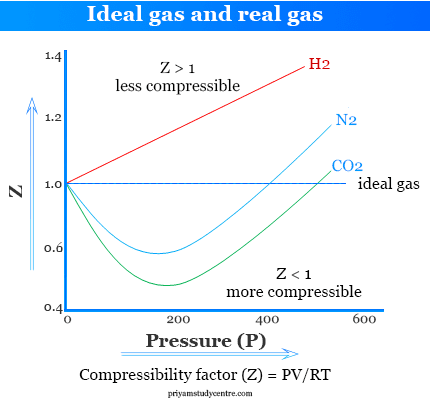
The behavior of gases can be categorized into ideal and real gas models, each with distinct characteristics. An **ideal gas** is a theoretical construct that adheres to Boyle's Law under all temperature conditions. When plotting PV/RT versus P at a constant temperature for an ideal gas, the result is a horizontal line, indicating that the product PV/RT remains constant. Ideal gases are characterized by having no intermolecular attractions, meaning they cannot be liquefied, and their constituent particles are assumed to have negligible volume. In contrast, a **real gas** deviates from ideal behavior, particularly at low temperatures and high pressures. Real gases only approximate Boyle's Law at high temperatures. A plot of PV/RT versus P at a constant temperature for a real gas typically produces an Amagat curve, which shows deviations from the ideal horizontal line. Unlike ideal gases, real gases possess intermolecular attractions, allowing them to be liquefied, and their particles occupy a finite volume. The point where a gas's behavior aligns with the horizontal line on a PV/RT vs. P plot indicates that it is behaving like an ideal gas at that specific pressure. It is also observed that as pressure increases, heavier gases tend to be more compressible due to stronger intermolecular forces, while lighter gases are less compressible due to weaker intermolecular forces and higher kinetic energy.
Diagram

The Ideal Gas Assumption in Introductory Gas Laws

It is crucial to remember that all introductory gas laws, including Boyle's Law, Charles's Law, and Gay-Lussac's Law, are based on the fundamental assumption that the gases behave ideally. This simplification allows for straightforward mathematical relationships but means that real gases will show some deviation from these laws, especially under extreme conditions.

Charles's Law: The Direct Relationship Between Volume and Temperature

For a fixed mass of gas maintained at a constant pressure, the volume is directly proportional to its absolute temperature. This principle is known as Charles's Law and can be expressed as V/T = constant (k). Therefore, if a gas undergoes a change in volume from V1 to V2 and a corresponding change in absolute temperature from T1 to T2, the ratio of its initial volume to initial temperature will equal the ratio of its final volume to final temperature: V1/T1 = V2/T
Diagram
2. A graph of an ideal gas obeying Charles's Law illustrates that the gas volume theoretically becomes zero at 0 Kelvin, which is absolute zero. Jacques Alexandre César Charles, a French inventor, scientist, mathematician, and balloonist, is credited with this discovery.

Applying Charles's Law: A Calculation Example

Consider a gas with an initial volume of 50 m3 at a temperature of 127 °C. To calculate the final temperature (in °C) required to decrease its volume to 20 m3 at a constant pressure, Charles's Law (V1/T1 = V2/T2) must be applied. It is essential to convert all temperatures to Kelvin before performing calculations.
Given: V1 = 50 m3
T1 = 127 °C + 273.15 = 400.15 K (approximately 400 K for this calculation)
V2 = 20 m3
T2 = ?
 Substituting these values into the equation:
50 m3 / 400 K = 20 m3 / T2 T2 = (20 × 400) / 50 T2 = 160 K
To convert this back to Celsius:
Final temperature = 160 K - 273.15 = -113.15 °C (approximately -113 °C)

The Necessity of Kelvin for Gas Law Calculations

Using the Kelvin temperature scale is imperative for gas law calculations because it represents absolute temperature, where 0 K signifies the theoretical point of no molecular motion. At 0 °C, gases still possess significant pressure and volume due to molecular motion. If Celsius temperatures were used, particularly negative values, the mathematical predictions for pressure or volume could become negative, which is physically impossible. The Kelvin scale avoids these mathematical inconsistencies by providing a true absolute zero point.

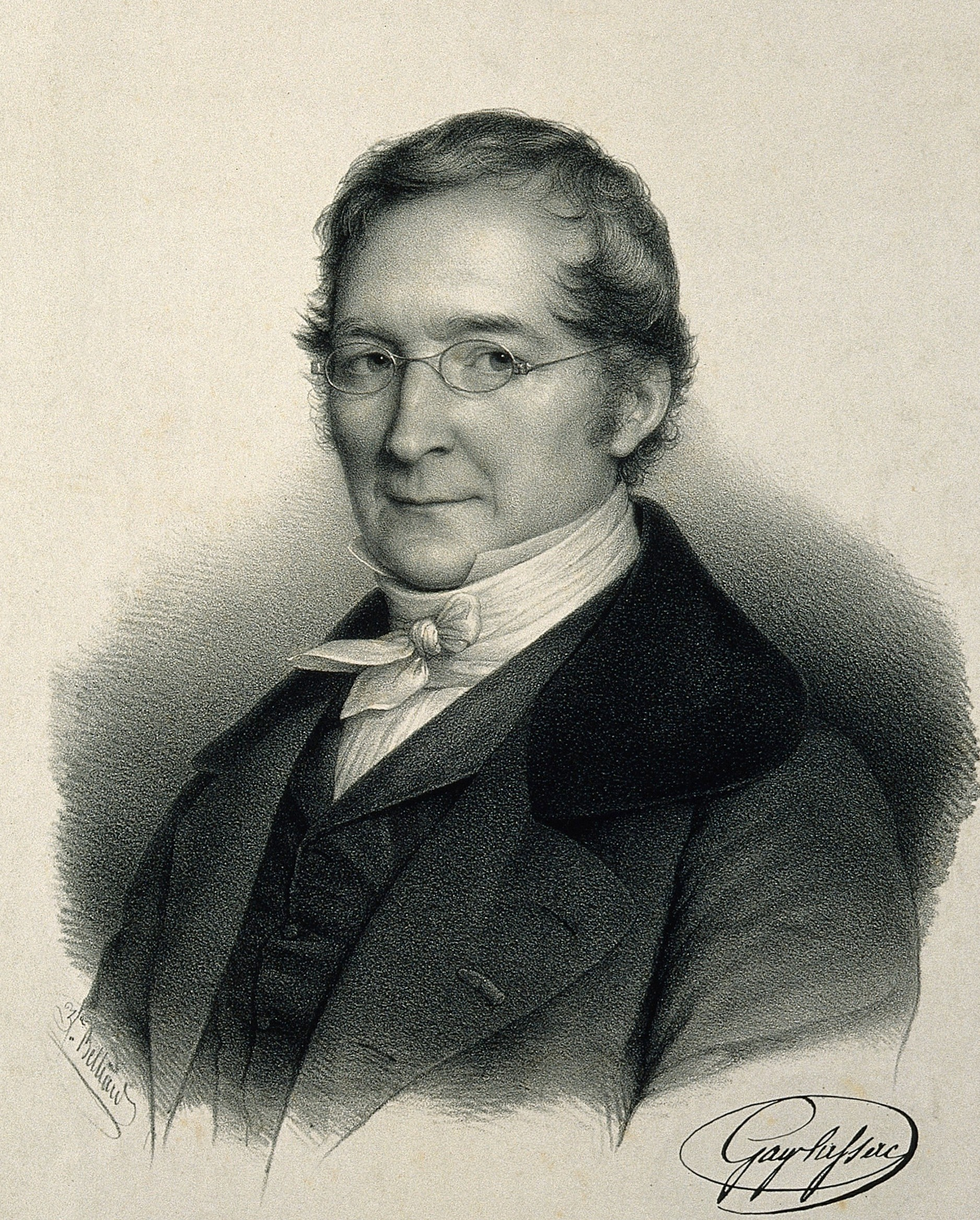
Gay-Lussac's Law: The Direct Relationship Between Pressure and Temperature

For a fixed mass of gas maintained at a constant volume, the pressure is directly proportional to its absolute temperature. This relationship is known as Gay-Lussac's Law and can be expressed as
P/T = constant (k). Consequently, if a gas undergoes a change in pressure from P
Diagram
1 to P2 and a corresponding change in absolute temperature from T1 to T2, the ratio of its initial pressure to initial temperature will equal the ratio of its final pressure to final temperature: P1/T1 = P2/T2. Joseph Louis Gay-Lussac, a French chemist and physicist, is credited with this law.

Applying Gay-Lussac's Law: A Calculation Example

Consider a gas with an initial pressure of 100 kPa at a temperature of 27 °C. To calculate the final pressure of this gas if its temperature is increased by 300 °C (resulting in a final temperature of 327 °C) at a constant volume, Gay-Lussac's Law (P1/T1 = P2/T2) must be applied. As with Charles's Law, all temperatures must be converted to Kelvin. Given: P1 = 100 kPa
T1 = 27 °C + 273.15 = 300.15 K (approximately 300 K for this calculation)
T2 = 27 °C + 300 °C + 273.15 = 600.15 K (approximately 600 K for this calculation)
P2 = ? Substituting these values into the equation:
100 kPa / 300 K = P2 / 600 K P2 = (100 × 600) / 300
Final pressure = 200 kPa

The Combined Gas Law

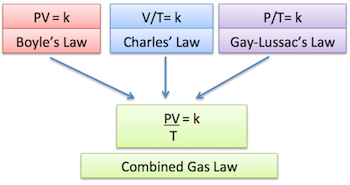
By combining Boyle's Law, Charles's Law, and Gay-Lussac's Law, we arrive at the combined gas law. This law describes the relationship between the pressure (P), volume (V), and temperature (T) of a fixed amount of gas. It states that the product of pressure and volume divided by temperature is a constant (k):

P x V / T = constant (k)

This relationship allows us to compare the initial and final states of a gas, provided the amount of gas remains constant:

P1 x V1 / T1 = P2 x V2 / T2

It is crucial to remember that temperatures in these calculations must always be expressed in Kelvin (K).

Applying the Combined Gas Law

To illustrate the application of the combined gas law, consider a scenario where a fixed mass of gas undergoes changes in pressure, volume, and temperature. For example, if a gas's pressure increases from 101 kPa to 303 kPa, its volume increases from 1 m3 to 6 m3 (a 5 m3 increase), and its initial temperature is 20°C, we can calculate its final temperature.

First, convert the initial temperature to Kelvin: T1 = 20°C + 273 = 293 K.

Using the combined gas law equation: P1V1 / T1 = P2V2 / T2

Substitute the given values:

(101000 Pa x 1 m3) / 293 K = (303000 Pa x 6 m3) / T2

Rearranging to solve for T2:

T2 = (293 K x 303000 Pa x 6 m3) / (101000 Pa x 1 m3)

T2 = 5274 K

Therefore, the final temperature of the gas is 5274 K.

Diagram
13
The Ideal Gas Law

The Ideal Gas Equation

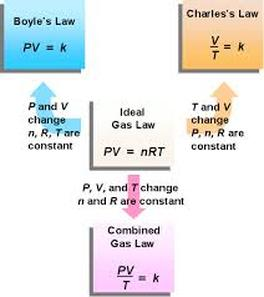
The combined gas law, P V / T = constant, can be further developed into the ideal gas equation by recognizing that the constant is directly proportional to the number of moles of gas (n). This constant is represented as nR, where R is the molar gas constant. Thus, the ideal gas equation is:

PV = nRT

In this equation:

  • P represents the pressure of the gas, typically measured in Pascals (Pa).
  • V represents the volume of the gas, typically measured in cubic meters (m3).
  • n represents the number of moles of the gas.
  • R is the molar gas constant, which has a value of 8.31 J K-1 mol-1.
  • T represents the absolute temperature of the gas, which must always be in Kelvin (K).

It is important to note that the value of the gas constant (R) can vary depending on the units used for pressure and volume. The relationship 1 J = 1 kPa dm3 or 1J = 1 Pa m3 is useful for understanding the units of R.

Characteristics of an Ideal Gas

An ideal gas is a theoretical concept that helps simplify the study of gas behavior. An ideal gas is defined as one that perfectly obeys Boyle's Law under all conditions of temperature and pressure. In reality, no gas is perfectly ideal, but many real gases behave very closely to ideal gases under conditions of high temperature and low pressure.

Diagram

Calculating Molar Volume at Standard Temperature and Pressure

The ideal gas equation can be used to calculate the volume occupied by one mole of an ideal gas at standard temperature and pressure (STP). Standard temperature is defined as 0°C (273 K), and standard pressure is typically 100 kPa (100,000 Pa).

Using the ideal gas equation: PV = nRT

Rearranging to solve for volume (V): V = nRT / P

Substituting the values for one mole of gas at STP:

V = (1 mol x 8.31 J K-1 mol-1 x 273 K) / 100,000 Pa

V = 0.0227 m3

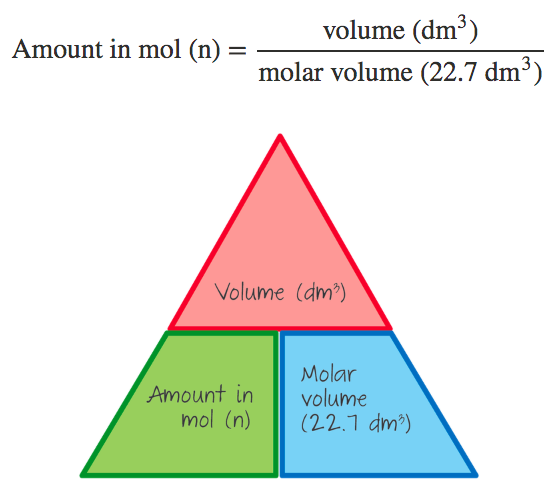
This volume can also be expressed as 22.7 dm3 (cubic decimetres) or 22.7 liters. This specific volume, 22.7 dm3, is known as the molar volume of an ideal gas at STP. It is a significant value because it represents the volume occupied by any ideal gas when one mole of it is present at standard temperature and pressure.

14
Experimental Molar Mass of a Gas

Determining the Molar Mass of a Gas from Experimental Data

The molar mass of a gas can be experimentally determined by utilizing the ideal gas law, PV = nRT, where P is pressure, V is volume, n is the number of moles, R is the ideal gas constant, and T is temperature. By rearranging this equation, the number of moles (n) can be calculated as n = PV/RT. Once the number of moles is known, and the mass of the gas is measured, the molar mass can be found by dividing the mass by the number of moles.

Applying the Ideal Gas Law to Calculate Molar Mass

To illustrate this, consider an example where a gas occupies a volume of 0.0056 m
Diagram
3 at a pressure of 101,000 Pa and a temperature of 273 K. Using the ideal gas constant R = 8.31 J mol-1 K-1, the number of moles (n) can be calculated as follows: n = (101,000 Pa × 0.0056 m3) / (8.31 J mol-1 K
Diagram
-1 × 273 K) = 0.25 mol If the mass of this gas is 10 g, then its molar mass is 10 g / 0.25 mol = 40. g mol-1.

Calculating Gas Volumes at Standard Temperature and Pressure (STP)

When dealing with gases at standard temperature and pressure (STP), it is often assumed that one mole of any ideal gas occupies 22.7 dm3. This approximation can be used to calculate the volume of a gas produced in a chemical reaction. Consider the reaction between 0.160 g of calcium carbide (CaC2) and excess water to produce ethyne (C2H2) gas, according to the equation: CaC2(s) + 2H2O(l) → C2H2(g) + Ca(OH)2(s) To calculate the volume of ethyne produced at room temperature and pressure:
  1. First, calculate the moles of CaC2: Moles of CaC2 = 0.160 g / 64 g/mol = 0.0025 mol.
  2. From the stoichiometry of the reaction, the mole ratio of CaC2 to C2H2 is 1:1. Therefore, moles of C2H2 = 0.0025 mol.
  3. Finally, calculate the volume of C2H2: Volume = 0.0025 mol × 22.7 dm3/mol = 0.0568 dm3.
Similarly, for the reaction of 3.25 g of zinc metal with excess acid to produce hydrogen gas: Zn(s) + H2SO4(aq) → ZnSO4(aq) + H2(g) The volume of hydrogen produced at room temperature and pressure can be calculated as:
  1. Moles of Zn = 3.25 g / 65.0 g/mol = 0.050 mol.
  2. The mole ratio of Zn to H2 is 1:1. Therefore, moles of H2 = 0.050 mol.
  3. Volume of H2 = 0.050 mol × 22.7 dm3/mol = 1.14 dm3.

Calculating Moles and Relative Molecular Mass of a Hydrocarbon

The ideal gas constant (R) is 8.31 J K-1 mol-1. This constant is crucial for calculations involving the ideal gas law. Let's consider an example where 0.688 g of a hydrocarbon occupies 472 cm3 at 98 kPa and 67 °C. To calculate the moles of hydrocarbon and its relative molecular mass:
  1. (i) Calculate the moles of hydrocarbon using PV=nRT:

    First, convert the given values to SI units:

    • Volume (V) = 472 cm3 = 4.72 × 10⁻⁴ m3
    • Pressure (P) = 98 kPa = 98000 Pa
    • Temperature (T) = 67 °C = 67 + 273 = 340 K

    n = (98000 Pa × 4.72 × 10-4 m3) / (8.31 J K-1 mol-1 × 340 K)

    n = 0.0164 moles

  2. (ii) Calculate the relative molecular mass of the hydrocarbon:

    Relative molecular mass = Mass / Moles = 0.688 g / 0.0164 moles = 42.03 g/mol

Further Calculations for Hydrocarbons: Molecular Formula, Combustion, and Stoichiometry

Based on the calculated relative molecular mass, further questions can be addressed regarding the hydrocarbon.
  1. (i) Suggest the molecular formula and name of the hydrocarbon:

    Given a relative molecular mass of approximately 42.03 g/mol, a possible molecular formula is C3H6, which corresponds to propene.

    • Molecular formula: C3H6
    • Name: Propene
  2. (ii) Give an equation for the complete combustion of the hydrocarbon:

    The complete combustion of propene (C3H6) with oxygen produces carbon dioxide and water:

    2C3H6 + 9O2 → 6CO2 + 6H2O

  3. (iii) Calculate the volume of oxygen needed to completely react with 0.21 g of the hydrocarbon under the same conditions:

    First, calculate the moles of propene:

    • Moles of propene = 0.21 g / 42.03 g/mol = 0.00500 mol

    From the balanced combustion equation, the mole ratio of C3H6 to O2 is 2:9. Therefore, the moles of O2 needed are:

    • Moles of O2 = 0.00500 mol C3H6 × (9 mol O2 / 2 mol C3H6) = 0.0225 mol O2

    Assuming the same conditions (which implies using the molar volume at those conditions, or if not specified, STP), the volume of oxygen needed is:

    • Volume of O2 = 0.0225 mol × 22.7 dm3/mol = 0.51 dm3