Calculating Kc from Equilibrium Concentrations
The equilibrium constant, Kc, quantifies the ratio of products to reactants at equilibrium for a reversible reaction. To calculate Kc, the equilibrium concentrations of all reactants and products are substituted into the equilibrium expression. For instance, consider the reaction: CO(g) + H2O(g) ⇌ H2(g) + CO2(g).
The equilibrium expression for this reaction is Kc = [H2][CO2] / [CO][H2O]. If the equilibrium concentrations are given as [CO] = 0.150 mol dm-3, [H2] = 0.200 mol dm-3, [H2O] = 0.0145 mol dm-3, and [CO2] = 0.0200 mol dm-3, then Kc can be calculated by substituting these values:
Kc = (0.200)(0.0200) / (0.150)(0.0145).
Introduction to ICE Tables
ICE tables are a powerful tool used to determine equilibrium constants (Kc) or equilibrium concentrations when not all equilibrium concentrations of reactants and/or products are initially known. The acronym "ICE" stands for Initial, Change, and Equilibrium, representing the concentrations of species at different stages of a reaction. It is crucial to ensure that the precision of any calculated answer aligns with the significant figures provided in the initial data.
Guidelines for Constructing ICE Tables
To effectively use an ICE table, begin by writing a balanced chemical equation for the reaction. Below this equation, create three rows labeled "Initial," "Change," and "Equilibrium."
- Initial: This row represents the concentrations of all reactants and products at the beginning of the reaction, before any significant reaction has occurred. Unless explicitly stated otherwise, it is generally assumed that the initial concentrations of products are zero.
- Change: This row quantifies the change in concentration for each species as the reaction proceeds from its initial state to equilibrium. A minus sign indicates a decrease in concentration (typically for reactants), while a plus sign indicates an increase (typically for products). The changes are determined by the stoichiometry of the balanced chemical equation, often represented by a variable 'x'.
- Equilibrium: This row represents the concentrations of all species once the system has reached equilibrium. The equilibrium concentration for each substance is calculated by adding or subtracting the "Change" from the "Initial" concentration (Equilibrium concentration = Initial concentration ± Change in concentration).
Once the equilibrium concentrations are determined, the equilibrium expression can be written, and Kc can be calculated by substituting these equilibrium values.
Calculating Kc from Initial and Equilibrium Concentrations using an ICE Table
Consider the reaction: PCl3(g) + Cl2(g) ⇌ PCl5(g). If we start with 0.20 mol of PCl3 and 0.10 mol of Cl2 in a 1.0 dm3 flask, and at equilibrium, the amount of PCl3 is 0.12 mol, we can use an ICE table to find Kc. First, convert amounts to concentrations by dividing by the volume (1.0 dm3). So, initial [PCl3] = 0.20 mol dm-3, initial [Cl2] = 0.10 mol dm-3, and equilibrium [PCl3] = 0.12 mol dm-3. The initial concentration of PCl5 is 0.00 mol dm-3.
| PCl3(g) | Cl2(g) | PCl5(g) | |
|---|---|---|---|
| Initial (mol dm-3) | 0.20 | 0.10 | 0.00 |
| Change (mol dm-3) | -0.08 | -0.08 | +0.08 |
| Equilibrium (mol dm-3) | 0.12 | 0.02 | 0.08 |
From the equilibrium concentration of PCl3 (0.12 mol dm-3) and its initial concentration (0.20 mol dm-3), the change in [PCl3] is 0.12 - 0.20 = -0.08 mol dm-3. Due to the 1:1 stoichiometric ratio between PCl3 and Cl2, the change in [Cl2] is also -0.08 mol dm-3. Therefore, the equilibrium [Cl2] = 0.10 - 0.08 = 0.02 mol dm-3. Similarly, the change in [PCl5] is +0.08 mol dm-3, making its equilibrium concentration 0.08 mol dm-3. Now, Kc can be calculated: Kc = [PCl5] / ([PCl3][Cl2]) = 0.08 / (0.12)(0.02) = 33.
Calculating Equilibrium Concentrations from the Equilibrium Constant
When the equilibrium constant (Kc) is known, it is possible to calculate the equilibrium concentrations of reactants and products. For the reaction CO(g) + 2H2(g) ⇌ CH3OH(g), if Kc = 0.500 at 350K, and the equilibrium concentrations of CO and H2 are 0.200 mol dm-3 and 0.155 mol dm-3 respectively, we can find the equilibrium concentration of CH3OH. The equilibrium expression is Kc = [CH3OH] / ([CO][H2]2). Substituting the known values: 0.500 = [CH3OH] / ((0.200)(0.155)2). Solving for [CH3OH] yields [CH3OH] = 0.500 * (0.200)(0.155)2 = 0.00240 mol dm-3, or 2.40 x 10⁻³ mol dm-3.
Calculating Equilibrium Concentrations from Initial Concentrations and Kc
In cases where only initial concentrations and Kc are given, an ICE table combined with algebraic manipulation is necessary to determine equilibrium concentrations. Consider the reaction SO3(g) + NO(g) ⇌ NO2(g) + SO2(g), with Kc = 6.78 at a specified temperature. If the initial concentrations of both NO and SO3 are 0.0300 mol dm-3, and initial concentrations of products are zero, we can set up an ICE table. Let 'x' represent the change in concentration.
| SO3(g) | NO(g) | NO2(g) | SO2(g) | |
|---|---|---|---|---|
| Initial (mol dm-3) | 0.0300 | 0.0300 | 0.00 | 0.00 |
| Change (mol dm-3) | -x | -x | +x | +x |
| Equilibrium (mol dm-3) | 0.0300-x | 0.0300-x | x | x |
Since the stoichiometric ratios are 1:1 for all species, the change in concentration for NO and SO3 is -x, and for NO2 and SO2 is +x. The equilibrium expression is Kc = [NO2][SO2] / ([SO3][NO]).
Substituting the equilibrium concentrations: 6.78 = (x)(x) / ((0.0300-x)(0.0300-x)) = x2 / (0.0300-x)2.
Taking the square root of both sides: √6.78 = x / (0.0300-x), which simplifies to 2.60 = x / (0.0300-x). Solving for x: 2.60(0.0300-x) = x → 0.0780 - 2.60x = x → 0.0780 = 3.60x → x = 0.0217.
Therefore, at equilibrium: [SO3] = [NO] = 0.0300 - 0.0217 = 0.00830 mol dm-3, and [NO2] = [SO2] = 0.0217 mol dm-3.
Approximations for Very Small Kc Values
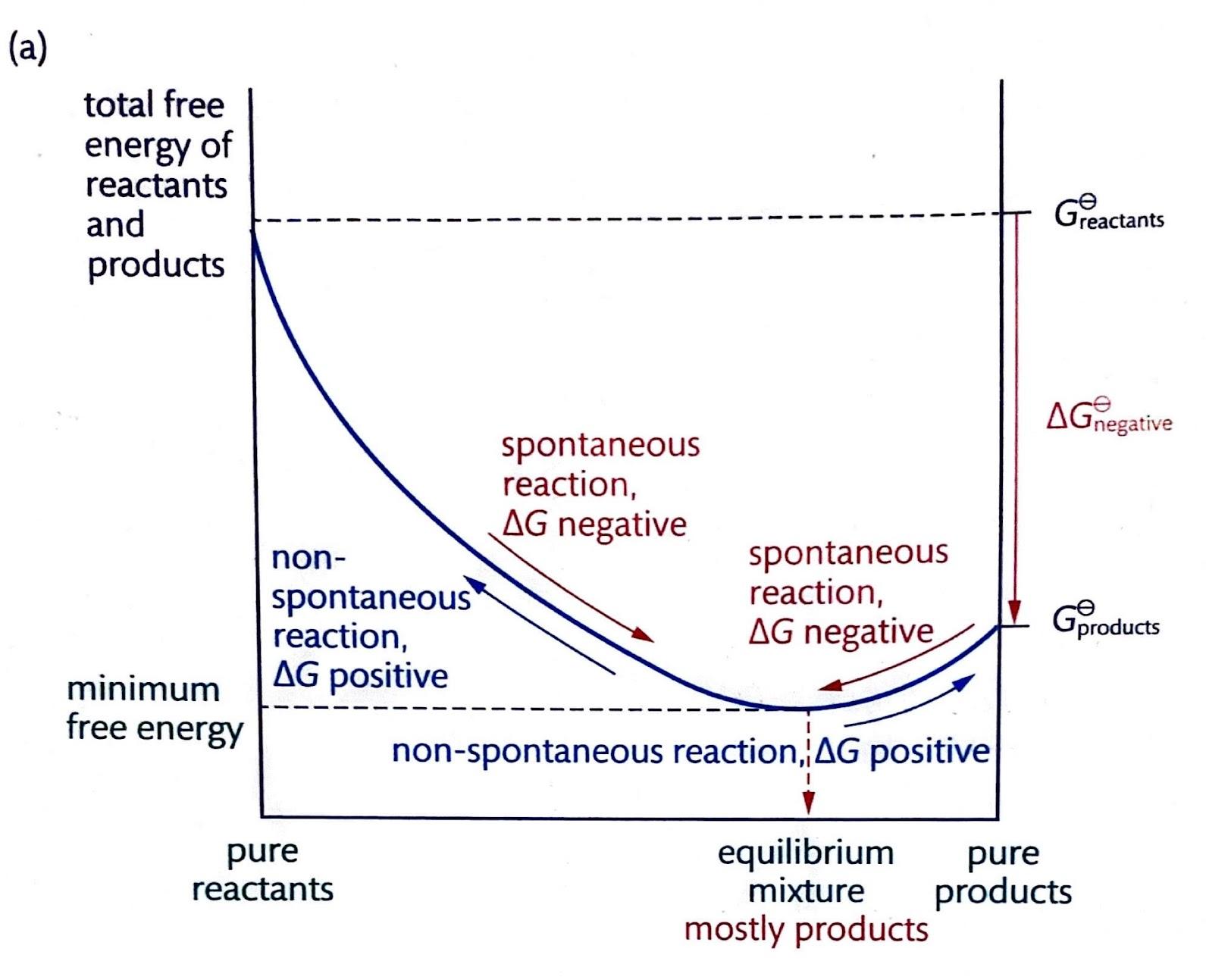
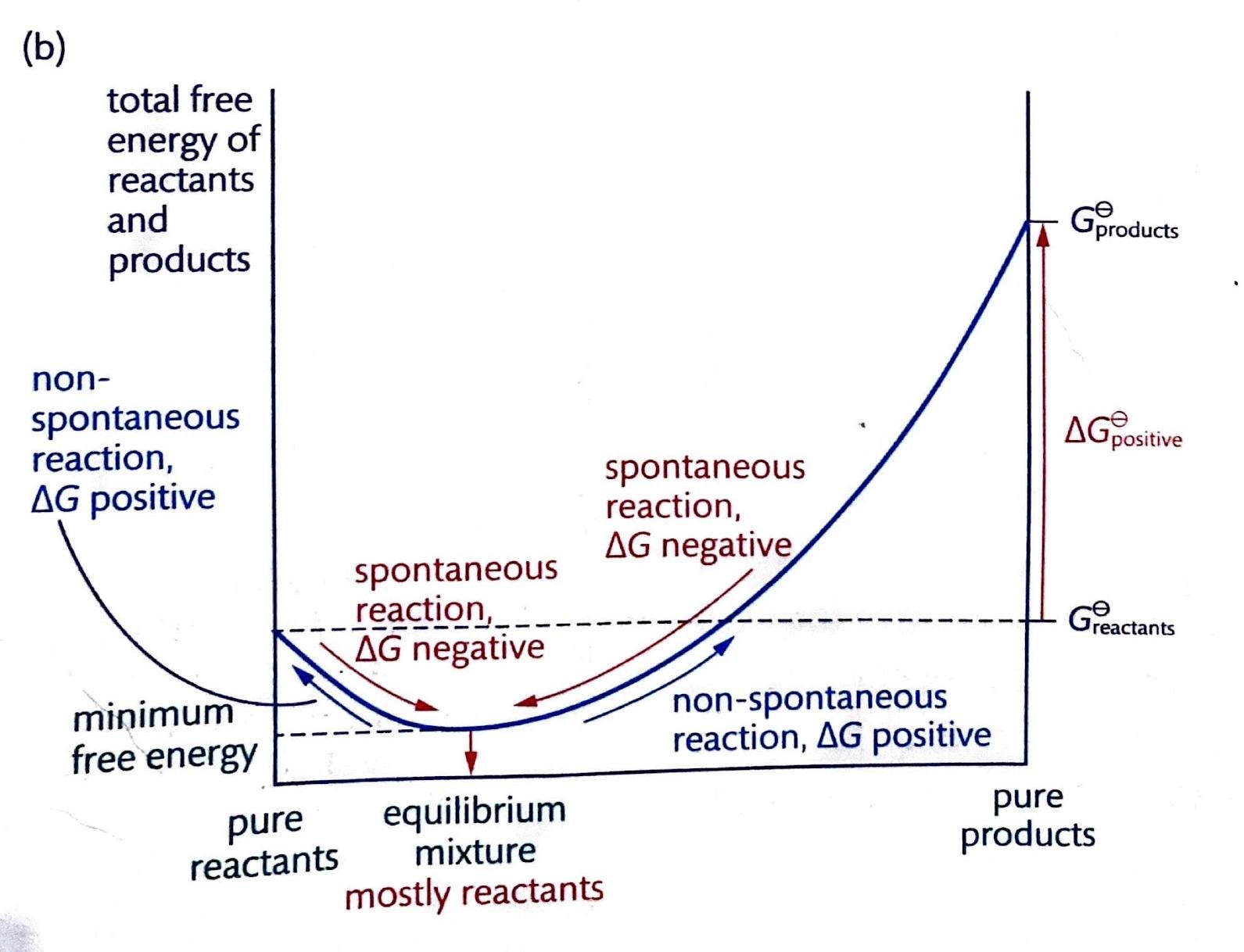
When the equilibrium constant Kc is very small (typically less than 10-3), it indicates that the reaction proceeds to a very limited extent, meaning very little product is formed at equilibrium. In such cases, the equilibrium mixture consists predominantly of reactants. Consequently, the change in reactant concentrations (represented by 'x' in an ICE table) is negligible compared to their initial concentrations. This allows for a simplifying assumption: the initial reactant concentrations are approximately equal to their equilibrium concentrations. This approximation significantly simplifies the algebra required to solve for 'x'.
Calculating Equilibrium Concentrations with a Very Small Kc
Let's consider the thermal decomposition of water: 2H2O(g) ⇌ 2H2(g) + O2(g). This reaction has a very small Kc = 7.3 x 10⁻¹⁸ at 1000°C. If the initial concentration of H2O is 0.10 mol dm-3, we can calculate the equilibrium [H2].
| 2H2O(g) | 2H2(g) | O2(g) | |
|---|---|---|---|
| Initial (mol dm-3) | 0.10 | 0.00 | 0.00 |
| Change (mol dm-3) | -2x | +2x | +x |
| Equilibrium (mol dm-3) | 0.10-2x | 2x | x |
The equilibrium expression is Kc = [H2]2[O2] / [H2O]2. Substituting the equilibrium concentrations:
7.3 x 10-18 = (2x)2(x) / (0.10-2x)2.
Since Kc is very small, we can assume that 0.10 - 2x ≈ 0.10.
This simplifies the equation to: 7.3 x 10-18 = (4x2)(x) / (0.10)2 = 4x3 / 0.01.
Rearranging to solve for x: 4x3 = (7.3 x 10⁻¹⁸)(0.10)2 = 7.3 x 10⁻²⁰.
Therefore, x3 = 7.3 x 10⁻²⁰ / 4 = 1.825 x 10⁻²⁰.
Taking the cube root, x = 2.632 x 10⁻⁷.
Finally, the equilibrium concentration of H2 is 2x = 2(2.632 x 10⁻⁷) = 5.3 x 10⁻⁷ mol dm-3.